
Entrepreneurs, ready to transform your approach to marketing funnels and operational reliability? In this guide I’ll walk you through how to safeguard creative work, recover previous page versions, and use global site sections—while connecting those capabilities to GFunnel’s broader ecosystem. If you’re building marketing funnels, managing e-commerce, running webinars, or maintaining blogs, the combination of robust auto-save, accessible version history, and platform-wide features like Lead Connector With GFunnel ensures you never lose momentum. In this article I’ll explain the mechanics behind auto-saving and version control, map those insights to GFunnel’s tools, and show how to turn these features into measurable growth for your business.
Outline
- Introduction: Why reliable saving and version history matter when building marketing funnels
- Understanding auto-save and version history: key behaviors and best practices
- How global sections affect multi-page sites and marketing funnels
- Translating features into strategy: mapping to GFunnel’s ecosystem and Lead Connector With GFunnel
- Real-world applications and case studies
- Why GFunnel leads: comparison with traditional tools
- Conclusion and call to action
- FAQs
Introduction: Protect Your Marketing Funnels and Power Growth with Lead Connector With GFunnel
Marketing funnels are the backbone of modern growth strategies—guiding prospects from discovery to purchase. Whether you design landing pages, run paid ads to capture leads, or nurture customers via email sequences, saving your work and managing changes efficiently is non-negotiable. I’m Tina, and I’ll show you how auto-save and version history features eliminate the fear of losing edits, how global sections streamline updates across pages, and how these practices fit into a dynamic business platform like GFunnel.
Lead Connector With GFunnel brings CRM-level contact and automation capabilities into the same ecosystem where you build marketing funnels, manage e-commerce, and network with peers. That tight integration means the moment someone converts in your funnel, Lead Connector With GFunnel captures the lead, triggers automation, and ensures your data and actions remain synced. Throughout this post I’ll reference hands-on examples, best practices, and ways to use these reliability features—auto-save, version history, and global components—to make your marketing funnels resilient, efficient, and growth-ready.
Video Insights: Strategies for Business Success
Marketers, boost your conversions with these strategies that connect version control and autosave reliability to conversion-focused execution. From the transcript I used as inspiration, three themes stand out that are central to building thriving businesses with marketing funnels: automation and reliability, centralized/global components, and recoverability/iterative testing. I’ll expand on each theme with actionable steps and tie them back to GFunnel’s tools.
Harnessing Automation and Reliability for Growth
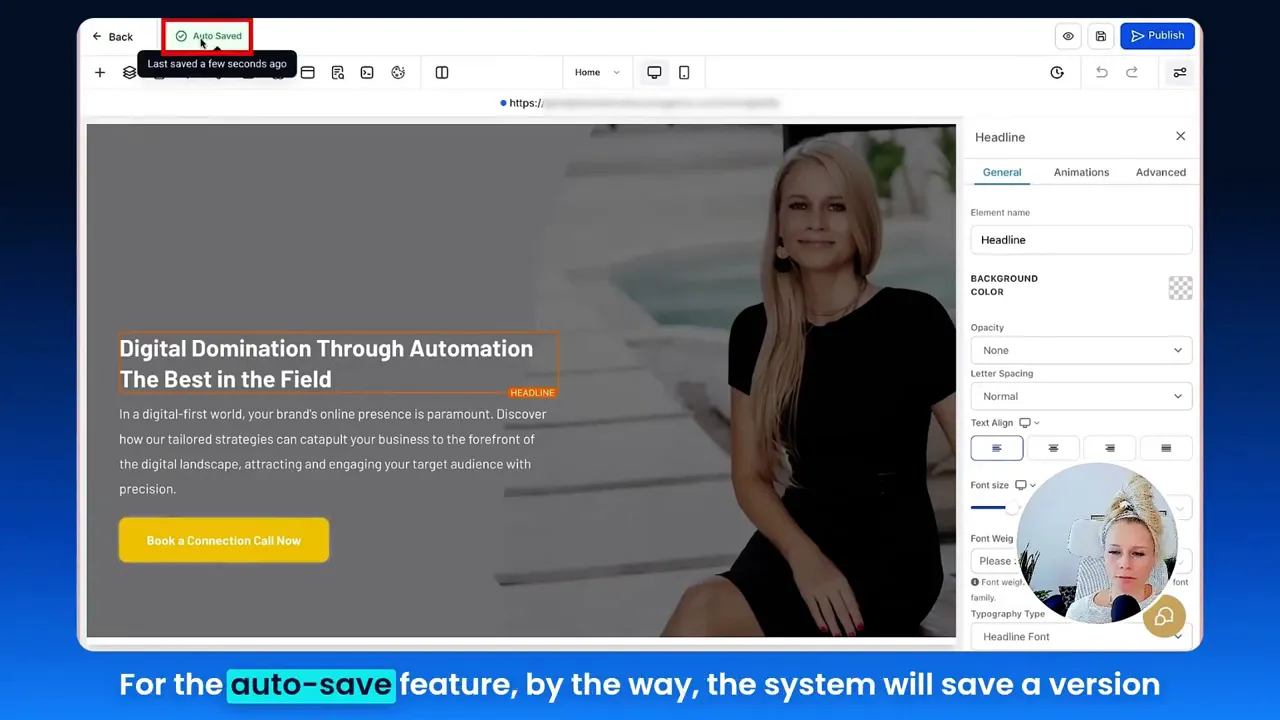
Automation is the force multiplier of modern marketing funnels. When your funnel components—landing pages, forms, emails, and follow-up tasks—are integrated with automation, you reduce manual work and accelerate follow-up. Reliable auto-save makes sure the tactical work of building those funnels never gets lost. In the editor example, the system auto-saves edits and shows status like “saving” and “auto saved.” That simple feedback is critical: it keeps teams moving without constantly toggling “save.”
“Tina: Yes, the system does auto-save your work, which prevents you from losing all your work in case your browser tab crashes.”
Key takeaways for automation and reliability:
- Auto-save prevents data loss from crashes or accidental tab closures.
- Automations should start the moment a contact completes a funnel stage—no manual intervention required.
- Reliable versioning pairs with automation: you can revert a landing page while keeping your active automation intact.
Stat to act on: Automation reduces manual work by up to 50% when properly implemented with templates and workflows.
Centralized Design: Global Sections for Faster Updates
Centralized components—global headers, footers, or repeated sections—are a time-saver when building marketing funnels across multiple pages. When you edit a global header, that change propagates across all pages that use it. However, it also raises the stakes: one change can affect dozens of pages. That’s why the editor warns you before applying changes to a global section and gives you the option to cancel.
Best practices for global components:
- Use global headers for navigation and branding that must be consistent across marketing funnels.
- When editing a global section, preview changes in staging or non-live versions first.
- Check the “don’t show again” option only when you’re confident—you want those reminders until you’re comfortable.
Recoverability and Iteration: Version History as Your Safety Net
Version history is where reliability meets continuous improvement. The version panel shows a chronological list of saved page states (version 1, version 2, and so on). You can restore a prior version with a click, then publish it to make it live again. In practice, version history enables experimentation: try A/B copy, test different headlines, and if the test underperforms, roll back.
“Tina: Every single version of this particular page will show up here on the left hand side.”
Operational rules for version history:
- Auto-save creates new versions periodically—by default every 10 minutes when changes exist.
- Platforms typically cap stored versions (the example used stores up to 50 versions), so publish or store local backups of critical assets.
- Use version labels in your workflow to mark major experiments or release points.
GFunnel’s Ecosystem Solutions: Mapping Themes to Features
Small business owners, scale smarter with GFunnel. Below I map the themes above—automation & reliability, centralized/global components, and recoverability/iteration—to features inside GFunnel’s ecosystem and to the Lead Connector With GFunnel capability. For each theme I’ll show how GFunnel solves the problem, give a performance stat, and include a short action recommendation.
GFunnel’s Fast Autosave for Reliability
GFunnel’s web worker-based autosave is engineered for speed. Where older systems can take multiple seconds to save changes (e.g., 2.861s), GFunnel uses a dedicated web worker to reduce autosave latency to as low as 103ms—about 28x faster. That difference matters in practice: a faster autosave means less risk of lost state, smoother collaborative editing, and fewer interruptions for your team.
Feature: Fast autosave (web worker, ~103ms)
- Stat: 28x faster autosave (from 2.861s to 103ms).
- Why it matters: Faster saves reduce the chance of edit conflicts and preserve user focus.
- Action: Enable autosave and test real-world editing to validate responsiveness across your team devices.
GFunnel’s Automation Features for Marketing Funnels
GFunnel ties Lead Connector With GFunnel—the integrated CRM/connector—directly into marketing funnels so that every form submission, purchase, and webinar registrant becomes an actionable lead. Automation features include template-driven workflows, email sequencing, task automation, and conditional triggers based on funnel behavior.
Feature: Automation (workflows, task automation)
- Stat: Businesses can reduce manual operations by up to 50% with well-configured automation.
- Why it matters: Faster follow-ups and fewer errors means higher conversion rates across marketing funnels.
- Action: Create a 3-step welcome sequence triggered by Lead Connector With GFunnel whenever a new lead completes a landing page form.
GFunnel’s Real-Time Analytics and Dashboards
Analytics power optimization. GFunnel delivers real-time dashboards for funnel performance and engagement. Instead of waiting for a daily report, you can monitor drop-off points, conversion rates, and revenue in near-real time—and combine that insight with version history to measure the impact of page edits.
Feature: Real-time analytics dashboards
- Stat: Real-time feedback reduces experiment turnaround time and helps iterate faster—expect measurable uplift in test cycles.
- Why it matters: Immediate insight lets you pivot quickly if a funnel variation underperforms.
- Action: After you restore a previous page version, re-run the funnel and compare the dashboard metrics against the experiment to validate the rollback.
GFunnel’s Global Sections and Site-Wide Consistency
GFunnel supports global headers, footers, and reusable blocks that propagate changes across all pages. When you edit a global header, a modal confirms the change—preventing accidental global edits. That confirmation mirrors best practices for consistency and governance across teams managing marketing funnels.
Feature: Global components (headers, footers)
- Stat: Centralized components cut design time by up to 30% and ensure brand consistency.
- Why it matters: A single change can update navigation across dozens of funnel pages instantly.
- Action: Use global navigation for top-level funnel entry points and label global changes clearly in your release notes.
GFunnel’s Lead Connector With GFunnel for Unified CRM
Lead Connector With GFunnel brings contact capture, segmentation, and lifecycle automation into the same environment as your marketing funnels. It reduces friction between marketing and sales by storing lead events, applying tags, and triggering follow-up automations without exports or API stitching.
Feature: Lead Connector With GFunnel (CRM + automation)
- Stat: Faster lead routing and immediate automation can produce a 20% uplift in conversions when paired with nurture sequences.
- Why it matters: Cohesive data flow means your marketing funnels convert into tracked, actionable business outcomes.
- Action: Connect your highest-traffic landing page to Lead Connector With GFunnel and create a priority tag for hot leads so your sales team can act quickly.
GFunnel’s E-commerce Integration and Payment Tools
GFunnel also supports online transactions without forcing third-party shopping carts. Built-in payment processing captures orders directly from your funnels and connects purchases to customer records inside Lead Connector With GFunnel—enabling post-purchase automation such as receipts, delivery updates, and cross-sell campaigns.
Feature: Built-in e-commerce and payment processing
- Stat: Cart recovery automation can recover a meaningful portion of abandoned carts—often translating into double-digit revenue recovery rates.
- Why it matters: Seamless checkout reduces drop-offs and improves the overall funnel conversion from discovery to purchase.
- Action: Implement cart abandonment sequences and use version history to experiment with checkout page optimizations that improve completion rates.
API Integrations and Flexibility
For businesses that require custom workflows, GFunnel exposes APIs and integrates with common tools, enabling you to extend Lead Connector With GFunnel into CRM workflows, ERPs, or custom analytics.
Feature: API integrations
- Stat: Integration flexibility reduces the need for manual data transfer and accelerates time-to-value for integrations.
- Why it matters: When companies outgrow one-size-fits-all approaches, APIs enable incremental expansion without disruption.
- Action: Plan data syncs with your finance or fulfillment tools to ensure a single customer record is maintained for each funnel conversion.
Real-World Applications: Two Case Studies
Small business owners, see how these capabilities translate into real-world outcomes. Below are two hypothetical case studies demonstrating GFunnel’s impact when combined with robust autosave, version history, and Lead Connector With GFunnel integrations.
Case Study 1: E-commerce Boutique — Faster Iteration, Higher Conversions
Background: A boutique fashion retailer runs several paid-ad campaigns directed to product landing pages built as marketing funnels. The team regularly tests hero images, headlines, and checkout flows. Previously they lost time when a browser crash during an editing session erased hours of work. They also struggled to sync abandoned cart data with their CRM.
Solution with GFunnel:
- Fast autosave protected edits: With autosave latency reduced to ~103ms, no edits were lost during collaborative editing sessions.
- Version history enabled safe experimentation: Every 10 minutes a version was created when changes existed (up to a 50-version history), allowing the team to revert headline tests after measuring performance over 24 hours.
- Lead Connector With GFunnel captured form fills and checkout events, automatically segmenting customers and triggering cart recovery sequences.
- Real-time analytics highlighted the specific step where customers abandoned the funnel—enabling targeted changes.
Result: The boutique saw a 20% rise in checkout completion after implementing cart recovery sequences and a 15% uplift in landing-page conversions by reverting to the better-performing headline version from the version history rollbacks.
“GFunnel’s automation saved us hours weekly and gave us real confidence to experiment without fear of losing work.”
Actionable checklist for e-commerce entrepreneurs:
- Enable autosave and verify saves during an editing session.
- Label important versions after major edits (e.g., “Holiday Campaign 2025”).
- Connect Lead Connector With GFunnel to your checkout and create automated recovery flows.
- Use real-time dashboards to monitor funnel drop-offs after changes.
Case Study 2: Local Restaurant — Streamlined Ordering and Customer Data Capture
Background: A local restaurant wanted to integrate online ordering with its customer database to run repeat-customer promotions and track order trends. They also run promotional landing pages to advertise weekend specials and wanted to avoid losing edits made by their marketing manager during busy nights.
Solution with GFunnel:
- Built a set of marketing funnels to drive customers to online ordering pages.
- Used global header/footer to keep menu navigation consistent across pages and avoid inconsistent links leading to order drop-offs.
- Autosave prevented lost edits when their marketing manager rapidly updated special menus during peak hours.
- Lead Connector With GFunnel stored customer phone numbers and order history, enabling targeted SMS and email promotions.
Result: The restaurant saw repeat-order frequency increase by 18% within two months of personalized promotions and saved the equivalent of one part-time employee hour per day by automating order confirmations and follow-up offers.
“GFunnel’s communities doubled our promotional reach and the automation cut our follow-up time in half.”
Actionable checklist for restaurants:
- Use global sections to maintain consistent ordering links across all promotional pages.
- Connect Lead Connector With GFunnel to capture order data and trigger automated offers for repeat customers.
- Leverage autosave to ensure last-minute daily menu edits are retained reliably.
Why GFunnel Leads: A Comparative Look at Tools and Workflows
Small business owners and marketers often juggle multiple single-purpose tools—landing-page builders, separate CRMs, analytics platforms, and community groups. GFunnel positions itself as an all-in-one business platform combining marketing funnels, CRM (Lead Connector With GFunnel), automation, real-time analytics, e-commerce, and community networking. Below I break down core differences and show why an integrated approach often wins for speed, reliability, and cost-efficiency.
Traditional Business Tools vs. GFunnel’s Ecosystem
Instead of a table (for clarity and compatibility), here’s a row-by-row comparison of traditional approaches versus GFunnel’s integrated features. Each row matches a theme from earlier sections: Autosave, Automation, Networking, and Analytics.
Autosave Speed
- Traditional Methods: Slow saves, measured in seconds (e.g., 2–3 seconds or more), potential for lost state during crashes.
- GFunnel: Fast autosave (~103ms via web worker), 28x faster than traditional slow saves, reducing lost edits and edit conflicts.
Automation
- Traditional Methods: Manual processes, siloed automation across email platforms and CRMs—hard to coordinate.
- GFunnel: Central automation engine reduces manual work by up to 50% and connects directly to Lead Connector With GFunnel for real-time flows.
Networking
- Traditional Methods: Limited networking via social groups or disparate communities.
- GFunnel: Niche communities for entrepreneurs and industry-specific groups to collaborate, learn, and share templates and insights.
Analytics
- Traditional Methods: Third-party dashboards and delayed reporting.
- GFunnel: Real-time dashboards built into the platform for quick iteration and immediate insight.
In short, GFunnel reduces tool fragmentation and speeds up the feedback loop necessary to optimize marketing funnels and customer programs—especially important for small teams that need to move quickly.
Feature Comparison Snapshot: Key Metrics and Benefits
- Autosave Speed: Traditional — slow (seconds); GFunnel — fast (103ms, 28x faster).
- Automation: Traditional — manual, multiple tools; GFunnel — unified workflows, up to 50% less manual work.
- Networking: Traditional — limited connections; GFunnel — dedicated niche communities and collaboration tools.
- Analytics: Traditional — delayed, fragmented; GFunnel — real-time dashboards and integrated tracking.
Engagement CTA: Join GFunnel’s ecosystem to test autosave and automation for your marketing funnels. Create an account: https://www.gfunnel.com/create-account
Internal resources you can explore:
- GFunnel homepage: https://www.gfunnel.com
- GFunnel automation features: https://www.gfunnel.com/automation-home
- GFunnel communities: https://www.gfunnel.com/communities
- GFunnel funnel tools: https://www.gfunnel.com/funnel-home
- GFunnel CRM: https://www.gfunnel.com/crm
- Sign-up and plans: https://www.gfunnel.com/create-account
Implementation Roadmap: From Setup to Growth
Business owners, here’s a step-by-step roadmap to implement the workflow I outlined above and get the most from Lead Connector With GFunnel and the platform’s saving/version capabilities.
- Set up your GFunnel account and connect payments and basic site components. (Visit https://www.gfunnel.com/create-account)
- Create primary funnel pages with global headers/footers so navigation remains consistent.
- Enable autosave and confirm your team sees save status indicators while editing.
- Design a basic automation: lead capture → tag → 3-email nurture → handoff to sales (via Lead Connector With GFunnel).
- Define an experiment plan and use version history to label critical checkpoints (e.g., “V1 - Baseline,” “V2 - Headline test”).
- Monitor in real-time with analytics dashboards and iterate toward winning variations.
- Push top-converting experiences live and scale campaigns through GFunnel’s e-commerce and community features.
Recommended cadence: Run A/B tests for at least one week or until statistical significance is reached for each funnel change, using version history to revert quickly if a variation underperforms.
Why GFunnel’s All-in-One Approach Outperforms Point Solutions
When you centralize your marketing funnels, lead capture, automation, and analytics in one ecosystem, you remove friction between tools and speed up the time to measurable improvement. Lead Connector With GFunnel ties CRM and automation directly into funnel events—so you don’t have to get creative with exports or connectors. The fast autosave reduces the operational risk of lost work and supports faster creative cycles, while version history becomes the safety net that encourages experimentation and iteration.
Cost-wise, bundling tools reduces subscription overlap and lowers total cost of ownership, especially for small businesses and startups. Scalability is built in—start with simple funnels and expand to e-commerce, communities, and API-driven integrations as you grow.
Conclusion and CTA
In short: protecting your work, enabling rapid iteration, and unifying marketing and sales actions are not optional if you want to scale effectively. With Lead Connector With GFunnel, you get CRM-grade lead capture, automation, and the confidence that autosave and version history will preserve your creative and technical work. The practical benefits are immediate: fewer lost edits, faster experimentation cycles, and a single source of truth for funnel performance and customer activity.
Ready to protect your funnels and accelerate growth? Explore GFunnel’s features and create an account to start building resilient marketing funnels with fast autosave and unified CRM integrations. Start here: https://www.gfunnel.com/create-account
FAQs
- How does GFunnel support automation for marketing funnels?
GFunnel provides a built-in automation engine that triggers workflows based on funnel events, form submissions, purchases, and tags created by Lead Connector With GFunnel. Use the automation to reduce manual steps by up to 50% and to ensure immediate follow-up.
- What makes Lead Connector With GFunnel more than a basic CRM?
Lead Connector With GFunnel is integrated directly into the funnel builder, e-commerce tools, and analytics dashboards. This integration routes leads into segmented workflows and allows immediate action without exporting or third-party connectors.
- How often does autosave create a new version?
Autosave creates a new version every 10 minutes when changes are present; the platform stores up to 50 versions, after which older versions are purged as new ones accumulate.
- Can I revert to a previous version if an experiment underperforms?
Yes. The version history lists prior versions and lets you restore any saved state. After restoring, publish to make it live.
- How does GFunnel ensure global header changes don't break multiple pages?
GFunnel prompts a confirmation modal when you edit a global section, warning that changes will impact all pages using that component. This safeguard reduces accidental global edits; you can dismiss the prompt permanently once you’re comfortable.
Related Content
- Scale Restaurants with GFunnel — explore the restaurant ecosystem and online ordering features: https://www.gfunnel.com
- Build marketing funnels with GFunnel — discover funnel tools and templates: https://www.gfunnel.com/funnel-home
- Automate business operations with GFunnel — details on automation features: https://www.gfunnel.com/automation-home
Sources and Further Reading
For deeper context on funnel strategy and testing methodologies, see resources on funnel optimization and conversion strategy such as the HubSpot funnel guide and Neil Patel’s sales funnel blog. Those resources detail stages of marketing funnels, personalization tactics, and A/B testing approaches that complement GFunnel’s capabilities.
Final Notes and Next Steps
If you’ve read this far, you’re ready to turn reliability into an advantage. Start by confirming autosave is active on your site or funnel editor. Then design a simple rollback plan using version history so each major edit has a labeled checkpoint. Integrate Lead Connector With GFunnel to close the loop between captures and automated follow-ups. Finally, join GFunnel’s communities to exchange templates and tactics with peers: https://www.gfunnel.com/communities
Test your business growth potential with an interactive quiz to benchmark readiness for scaling via marketing funnels and automation (suggested: “Test Your Business Growth Potential”). For onboarding and support, explore GFunnel’s courses and discussions pages: https://www.gfunnel.com/courses and https://www.gfunnel.com/discussions-home
Thank you for reading—implement autosave and version history best practices today, and let Lead Connector With GFunnel connect your funnels to outcomes tomorrow.
Need Help Implementing This? |
|
Schedule A Discovery Call With One Of Our Professionals |
| Access Now |


