
There will come a moment when your goals no longer need motivation — they demand discipline. I'm the creator behind Think Rich Mindset Hub, and in this deep-dive article I walk you through the timeless principles inspired by Napoleon Hill and the video "How To Build Unstoppable Discipline | Napoleon Hill." If you want to turn desire into destiny, and intention into a life that consistently produces results, this piece is for you.
Napoleon Hill spent a lifetime studying the habits and mindsets of the most successful people of his time. His work—most famously Think and Grow Rich—reveals patterns that matter more than talent or luck. In the original video we explored how discipline acts as both the engine and the architecture of progress: the quiet builder of empires, the whisper that replaces fleeting motivation with sustained momentum.
In this article you’ll find a practical translation of those ideas into modern, actionable steps. I’ll explain why discipline is not punishment but freedom, how to build habits that automate success, how to pair willpower with systems, and how to design your environment so the path of least resistance points toward your goals. Along the way I’ll share quotes and examples, exercises you can apply today, and modern tools that embody Hill’s efficiency principles to help you execute faster.

- Introduction: Why discipline matters now more than ever
- Chapter 1: Foundations of success — desire, faith, and definiteness of purpose
- Chapter 2: Napoleon Hill’s 13 steps to riches—practical breakdown
- Chapter 3: Real-world applications—how people turn principles into results
- Chapter 4: Mindset techniques—visualization, autosuggestion, routines
- Chapter 5: Habits, time, and environment—how to build systems that conserve willpower
- Chapter 6: Overcoming instant gratification and embracing delayed reward
- Chapter 7: Accountability and mastermind groups—leverage and honesty
- Chapter 8: Becoming unstoppable—identity, integration, and forgiveness
- FAQs: Common questions answered
- Conclusion: Commit, act, and become
Introduction: Why Discipline Matters Now More Than Ever
We live in an era built for instant reward. Fast food, fast scrolling, on-demand everything. In the face of immediate gratification, discipline becomes the differentiator. As the video opens with a clear claim—“No one ever lost to the world. They lost to themselves.”—we are reminded that the battlefield is internal long before it is external.

That line captures the paradox: discipline is freedom. Freedom from procrastination, freedom from the mood swings that sabotage progress, freedom to design the life you want. Discipline is not a muzzle on joy; it’s the scaffolding that allows joy and contribution to scale. When you build your life around this idea, your environment, routines, and choices support long-term goals rather than short-term comforts.
In the pages below I translate those principles into a step-by-step path you can begin today. Each chapter includes practical exercises, examples, and small rituals that stack into a powerful, sustainable practice of discipline. Read through, choose one thing to start, and do it for thirty days. The compound returns will astonish you.
Chapter 1: The Foundations of Success — Desire, Faith, and Definiteness of Purpose
Napoleon Hill identified a pattern among the great achievers: they began with a burning desire and a definite purpose. Desire is not mere wishful thinking; it’s a clear, specific, emotionally charged objective that anchors every decision you make. Faith—here meaning belief in your own capacity and the inevitability of the outcome—turns desire into unstoppable force.
Hill's phrase “definiteness of purpose” explains something simple and profound: clarity reduces friction. When you know exactly what must be done, the mind wastes less energy on questioning. As the video states, “Until you have learned to control your mind, you will never control anything else.” That control begins with a single declaration: I have one aim, and I will align my actions to it.
How to build a definite chief aim
1) Write it down. Spend 30 minutes crafting a one-sentence statement of your most important goal. Make it measurable and time-bound.
2) Attach emotion. Why does this matter? Connect it to family, freedom, contribution, or identity.
3) Commit publicly. Tell one person—an accountability partner—what you will do and when you will report progress.

Hill observed that desire combined with persistent action becomes irresistible. But desire without plan dissipates. Faith without effort becomes wishful thinking. The formula looks like this: Burning Desire + Faith + Organized Plan + Persistent Action = Results. We’ll amplify each component in later chapters.
Chapter 2: Napoleon Hill’s 13 Steps to Riches — Practical Breakdown
Napoleon Hill outlined 13 steps that form the architecture of achievement. Rather than list them mechanically, we’ll explore the core ones most relevant to building discipline and translate them into modern practice.
1. Desire and Definiteness of Purpose
Desire is the starting point. Transform a vague hope into an objective by specifying numbers, dates, and impact. For example: instead of "I want a successful business," write "I will create a $10,000/month recurring revenue business by December 31st, 2025." The specific aim simplifies decision-making and fosters daily actions aligned with the target.
2. Faith and Autosuggestion
Autosuggestion is a method of reinforcing belief through repeated mental and vocal affirmation. Hill taught that the subconscious obeys dominant thoughts. Use short daily scripts—affirmations that describe your outcomes in present tense, spoken and written, daily. Visualize the feeling of achievement as well as the facts. This trains your brain to operate as if success is already in motion.

3. Specialized Knowledge
Knowledge alone is not power; applied knowledge is. Identify the specific skills the goal requires—marketing, sales, technical competence—and schedule deliberate learning blocks. Invest in one course or mentor and apply the lessons immediately. Knowledge must be converted into action to compound.
4. Imagination
Hill emphasized creative imagination as the engine of innovation. Imagination is not fluff; it’s a practical tool for designing systems, products, and strategic moves. Schedule creative time—short, interruption-free sessions where your mind is allowed to experiment and generate options.
5. Organized Planning
Once you have desire, faith, and knowledge, build a plan. But don’t fall into paralysis: organize weekly and daily tasks that directly contribute to your chief aim. Plan for obstacles and develop contingency steps. Organized planning converts desire into repeatable steps.
6. Decision
Indecision kills momentum. Decide quickly; change slowly. Napoleon Hill noted that successful people make decisions and stick to them. Train yourself to choose, then to execute the plan relentlessly. The act of deciding energizes willpower and reduces mental drain from constant re-evaluation.
7. Persistence
Persistence is the daily continuity of purpose. Hill called it the sustained effort necessary to induce faith and cause momentum. The video teaches that “if you don't sacrifice for what you want, what you want becomes the sacrifice.” Choose the short-term discipline now to avoid long-term regret.

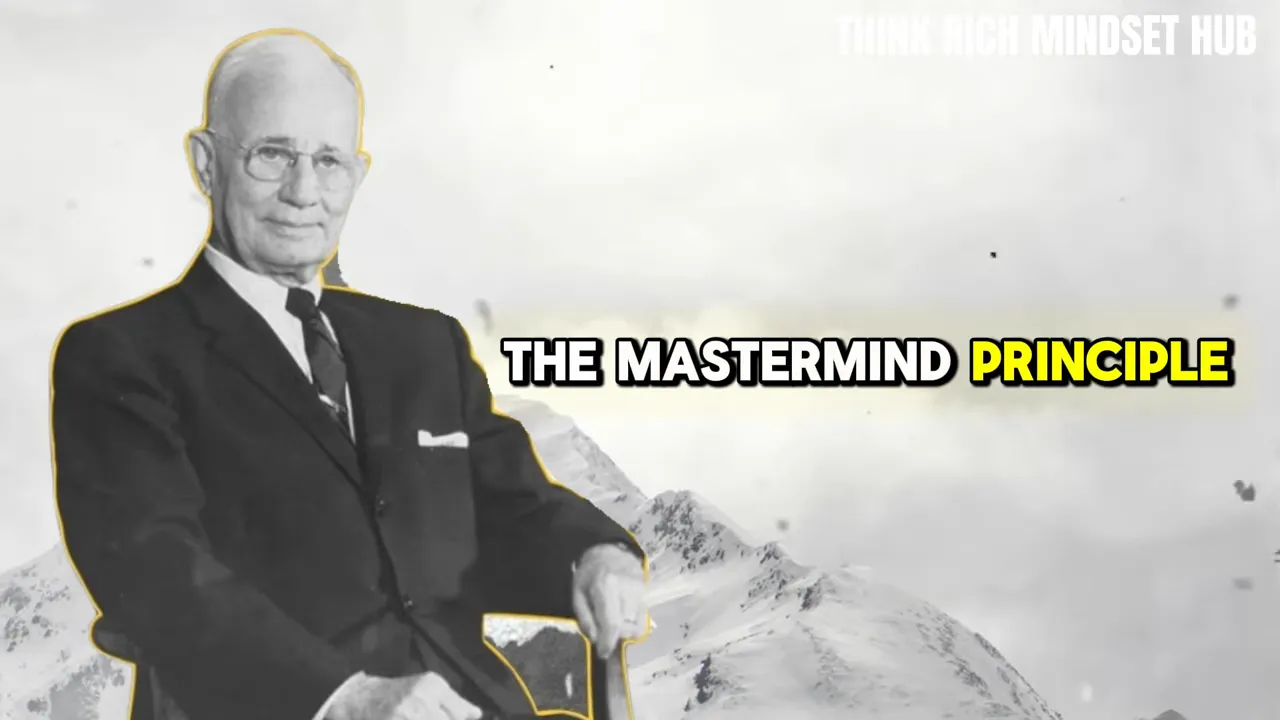
8. Power of the Master Mind
Teamwork multiplies results. A mastermind group is a small alliance of focused individuals who hold each other accountable, exchange insight, and expand opportunity. Hill said no one achieves great success alone. Build or join a mastermind to create feedback loops and accountability.
9. The Mystery of Sex Transmutation
Hill described redirecting energy into creative and productive outlets. Modern interpretation: channel intense emotion and drive into high-leverage actions. Redirecting surplus energy from distraction into creation strengthens focus and magnifies output.
10. The Subconscious Mind
Train it. Use visualization, autosuggestion, and daily rituals to load the subconscious with your chosen direction. Over time, your subconscious will generate ideas, opportunities, and resilience that align with your aim.
11. The Brain and the Sixth Sense
Hill posited that persistently applied discipline eventually unlocks intuitive insights. The “sixth sense” emerges as your experience and subconscious synthesize patterns, leading to rapid, confident decisions.
12. Overcoming Fear and Negative Influences
Fear and doubt are predictable. Respond to them with small acts of courage. Each time you act despite fear, you expand your capacity to act again. Replace fear-based narratives with evidence—small wins that prove your competence.
13. Sound Health and Balanced Living
Discipline must be holistic. Mental stamina depends on physical energy. Sleep, nutrition, and movement are not optional extras; they are the soil in which discipline grows. Schedule them as non-negotiables.

Those steps are not a checklist to be completed once; they are principles to be integrated into daily life. The path from desire to destiny is about repeated application, honest feedback, and the quiet accumulation of small wins. The rest of this article explores how to turn those steps into daily structure and measurable progress.
Watch this comprehensive exploration of Napoleon Hill’s principles in action and how to build unstoppable discipline.
Chapter 3: Real-World Applications and Stories
Philosophy becomes power only when applied. Here are practical stories and modern analogies that show how Hill’s principles translate into results today.
Case Study: The Early-Riser Entrepreneur
Meet a typical example: Mara (hypothetical), a creator with a side business. She sets a definite chief aim: grow an online coaching practice to $8,000/month in 12 months. She writes it down, attaches a why—financial independence for her family—and creates a morning routine that protects her prime creative hours.
Mara treats discipline like an identity: every morning at 5:00 she wakes, writes one prioritized revenue-generating task, does 30 minutes of focused work before social media, and practices a two-minute visualization of the next sale. Within 90 days, her content reaches a consistent cadence; six months in, momentum builds; at month 10 she crosses the $8,000 threshold. The variables were not luck but repeated small acts aligned to a purpose.

Modern Implementation: Automation and Systems
Hill’s emphasis on organized planning and systems has a modern partner in automation platforms. Tools that automate follow-ups, funnel prospects, and nurture relationships are modern forms of organized planning. When you reduce friction—automating administrative tasks—you conserve willpower for high-leverage decisions.
If you’re building a business, explore platforms that centralize CRM, funnels, and course delivery. The goal is not to replace discipline but to amplify it: systems carry the load when willpower is low. For practical tools that integrate community, funnels, and automation all in one place, see GFunnel at https://www.gfunnel.com and explore the platform's funnel and automation features at https://www.gfunnel.com/funnel-home and https://www.gfunnel.com/automation-home
How the Mastermind Multiplies Results
A mastermind provides three advantages: accountability, diversity of expertise, and consistent feedback. Whether you meet weekly to debrief, set milestones, or celebrate progress, the group converts private promises into public obligations. Napoleon Hill called this “organized habit” and insisted that no significant achievement happens in isolation.
Chapter 4: Mindset Techniques — Visualization, Autosuggestion, Routines
Discipline is mental training. This chapter gives you concrete techniques to shape your thinking and preserve willpower.
Visualization: Rehearse the Outcome
Before you act, see yourself succeeding. Vividly imagine the steps, the environment, the conversation, the feeling. Visualization primes the brain and creates neural pathways similar to actually doing the task. Practice 5–10 minutes of visualization each morning: imagine your completed product, the conversation with a client, the launch celebration. The subconscious begins working on solutions even while you’re “idle.”
Autosuggestion: Speak to Your Subconscious
Write a short script of affirmations that describe who you are becoming and what you achieve. Read it aloud every morning and night. Keep it concise, positive, and in present tense: “I am a person who delivers high-value coaching calls. I consistently attract clients who pay for transformation.” The repeated language rewires belief systems and turns discipline into habit.

Designing Unbreakable Routines
Routines conserve willpower. A rule I use: automate low-value decisions. For example, a fixed morning routine (wake time, movement, journaling, writing) prevents decision fatigue and reserves mental energy for strategic work. Build a non-negotiable anchor—one simple routine that starts and ends your day. Over time, the routine becomes identity, not effort.
Micro-Progress Rituals
When resistance is high, shrink the bar: do the one-minute version. If you can’t write a chapter, write one paragraph. If you can’t organize your inbox, archive 10 messages. These micro-acts break inertia and produce momentum. Discipline prefers small wins over grand promises that rarely get fulfilled.
Chapter 5: Habits, Time, and Environment — Building Systems That Conserve Willpower
Willpower is finite but predictable. The modern achiever wins by structuring time and space so decisions minimize drain. The video suggests focus blocks of 60–90 minutes, with breaks in between. That rhythm—deep work followed by recovery—prevents burnout and multiplies output.
Audit Your Time
Start with one week of tracking every minute. You will be shocked by the leaks. Identify low-value activities—scrolling, gossip, meetings without outcome—and cut them ruthlessly. Time is the only non-renewable resource. Protect it.
Focus Blocks and Recovery
Work in 60–90 minute focus blocks with no notifications, no tabs, and no multitasking. After each block, rest briefly: walk, breathe, hydrate. This rhythm sustains deep concentration and prevents decision fatigue.

Design Your Environment
Willpower loses when temptation is strong. Rearrange your space to make success easier: keep your phone in another room during focus blocks, remove junk food from sight, post your key priorities where you can see them. Make failure costly and success easy. Your environment should be an ally, not the enemy.
For entrepreneurs building funnels and online systems, use centralized tools to remove friction. Save time by using ready-made templates, CRM automation, and scheduling tools. Check out GFunnel’s funnel templates and CRM integration at https://www.gfunnel.com/crm and https://www.gfunnel.com/funnel-home to streamline repetitive tasks so your discipline can focus on high-value activity.
Chapter 6: Overcoming Instant Gratification — The Power of Delayed Reward
Instant gratification is the silent assassin of ambition. The modern age makes it easy to exchange long-term gains for immediate pleasure. The antidote is delayed gratification: the ability to endure short-term discomfort for future sovereignty.
Rewire Pleasure Association
Choose to find pleasure in process rather than outcome. Celebrate the small wins: the completed habit, not just the result. When you learn to enjoy the disciplined routine—training your body, refining your craft—you build a pleasure loop that favors growth.

The Bamboo Tree Metaphor
Hill’s bamboo parable is perfect: growth often happens unseen. For five years the tree seems static; then suddenly it shoots up 90 feet. Your work will compound beneath the surface. Stick to the process even when visible progress is slow. The breakthrough is often one small disciplined degree away.
Practical Steps to Build Delayed Gratification
- Delay small pleasures intentionally: wait 24 hours before impulse purchases.
- Build reward gates: only after completing a priority do you allow a leisure activity.
- Create earned pleasures: finetune the reward to your effort (celebrate with quality, not quantity).
Chapter 7: Accountability and the Mastermind — Harnessed Leverage
No one climbs alone. Accountability is the multiplier that turns private promises into public commitments. The video makes a clear case: your word to yourself matters, but your word to others carries different weight.
Find Your Circle
Surround yourself with people who demand growth. The wrong crowd normalizes mediocrity. The right circle lifts standards, prompts honest feedback, and creates systems of reciprocal accountability.

Accountability Systems You Can Implement Today
- Weekly check-ins: a 30-minute call with an accountability partner to review metrics.
- Public commitments: post a progress update in a community so non-performance carries social cost.
- Tools and trackers: use habit-tracking apps, journals, or shared document trackers. A visible record of progress reduces rationalization.
Use technology intentionally: set up shared dashboards to track goals, and automated reminders for milestones. For creators and entrepreneurs, platforms like GFunnel offer community and progress features that help you stay on course. Visit https://www.gfunnel.com/communities and https://www.gfunnel.com/goal-home to explore structured accountability options.
Mastermind Best Practices
- Limit size to 4–8 people for intimacy and focus.
- Meet regularly with an agenda and measurable outcomes.
- Mix complementary skills: someone strong in marketing, someone in operations, someone who asks hard questions.
- Rotate roles: have a member present a challenge and accept targeted feedback.
Chapter 8: Becoming Unstoppable — Identity, Integration, and Forgiveness
Discipline is more than behavior; it becomes identity. The moment you consistently keep promises, your self-image shifts from “I try” to “I am.” That identity is the most durable form of discipline because actions become automatic rather than forced.

Integration Over Compartmentalization
Discipline must touch every area of life—health, money, relationships, and mindset. If you're disciplined at work but chaotic with money, the cracks will spread. Integrate small non-negotiables across domains: wake up on time, eat clean, save a fixed percentage, and schedule weekly relationship check-ins. When each part supports the others, discipline compounds.
Forgiveness and Course Correction
Perfection is not the aim; persistence is. Slips are inevitable. The measure of discipline is how fast you reset. If you miss a day, correct immediately and move on. Habit formation is not punishment; it’s practice. Each reset reinforces trust with yourself. Napoleon Hill emphasized mastery of thought—use failure as feedback, not identity.
Practical 30-Day Integration Plan
Choose three non-negotiable actions across three domains—work, health, and money—and commit to them for 30 days:
- Work: Two 90-minute focus blocks daily on top revenue-generating activity.
- Health: 20 minutes of movement and a nightly sleep routine.
- Money: Automate a savings transfer and record daily expenses.
Review weekly. Log wins and missteps. Adjust and continue. Over time the integration becomes identity, and identity removes the need for constant effort.
FAQs
What is the definite chief aim and why is it essential?
A definite chief aim is a clear, specific purpose that anchors your decisions and actions. It reduces friction and mental drain, guiding daily choices. With a definitive aim, you replace scattered effort with targeted, compounding actions.
How does persistence lead to success?
Persistence is the consistent application of effort over time. It transforms small actions into momentum, rewires self-belief, and gives your subconscious the time to generate opportunities. Most people quit before compounding begins; persistence keeps you in the game long enough for breakthroughs.
How can I build habits that last?
Start small and be consistent. Use habit stacking—attach new actions to existing routines. Track progress to create awareness. Replace bad habits with positive ones and design your environment to make success easy and failure harder. Gradually expand actions once they become automatic.
What role does a mastermind group play in success?
A mastermind provides accountability, diverse expertise, and candid feedback. It accelerates learning, expands opportunity, and holds you to higher standards. Masterminds turn private commitments into public obligations, making discipline socially reinforced.
Where can I apply Napoleon Hill’s principles with modern tools?
Napoleon Hill’s principles translate into modern systems: automated funnels, CRM, community platforms, and habit trackers. For entrepreneurs, platforms like GFunnel (https://www.gfunnel.com) provide funnels, CRM, and community features that reflect Hill’s emphasis on organized planning and systems that conserve willpower.
Conclusion: Commit, Act, Become
Napoleon Hill taught that the gateway to riches, peace, and power begins with self-discipline. This is not a harsh demand to remove joy from life; it’s an invitation to design a life where your choices reflect your highest self. Discipline frees you from chaos and positions you to do what matters, day after day.

Start with one small commitment today: make your bed with attention, write one page, or execute one focused hour. Do it once. Do it again tomorrow. Let those small votes accumulate. The math of discipline is simple: small consistent actions compound into extraordinary results.
If you’re building something—business, art, health—use systems that honor your discipline. Tools that automate repetitive tasks, centralize community, and track progress are modern extensions of Hill’s organized planning. Explore resources and platforms that help you remove friction so your discipline can be used where it matters most: the work that moves the needle. Learn more about platforms that help entrepreneurs streamline execution at https://www.gfunnel.com and explore funnels and automation at https://www.gfunnel.com/funnel-home and https://www.gfunnel.com/automation-home
Remember the line: “Self-discipline begins with the mastery of your thoughts.” Master them. Lead yourself daily. The person you become is not the result of an isolated victory—it is the accumulation of choices, repeated when no one is watching. That is how ordinary people become extraordinary.
Commit to discipline. Command your mind. Build the life you were meant to live.
If this message moved you, share it with someone who’s ready to rise. You don’t have to search for motivation forever; build discipline, and everything else will follow.
Need Help Implementing This? |
|
Schedule A Discovery Call With One Of Our Professionals |
| Access Now |


