Entrepreneurs, ready to transform how you build marketing funnels and scale your business? In this guide I’ll walk you through practical strategies and platform-driven solutions inspired by a recent product announcement from a leading integration expert. That announcement — and the team behind it — highlights one clear truth: integrations, automation, and usability are the backbone of modern marketing funnels. As the author of that announcement and a product advocate, I’ll show how GFunnel expands on those principles to become more than a funnel builder — a complete business platform that connects teams, automates operations, helps you analyze performance in real time, and speeds up creative work with a fast autosave engine.
Whether you run a small e-commerce shop, manage multiple local businesses, or lead a marketing team, this article will guide you through themes of automation, integration, community networking, analytics, and performance — and map each of those themes to specific GFunnel capabilities. Along the way you’ll see actionable recommendations, real-world case studies, and a clear pathway to using GFunnel as your primary business platform. I’ll also reference a few direct insights from my product announcement to provide context and credibility — because product momentum matters when you plan growth strategies.
Outline
- Introduction: Why marketing funnels and platform ecosystems matter
- Video Insights: Key themes that drive modern funnels and business growth
- GFunnel’s Ecosystem Solutions: Mapping themes to features and outcomes
- Real‑World Applications: Case studies for an e‑commerce store and a restaurant
- Why GFunnel Leads: Comparison with traditional tools and competitors
- Conclusion and Calls to Action
- FAQs
Introduction: Marketing funnels at the center of an all‑in‑one business platform
Marketing funnels remain the most practical framework for converting awareness into revenue. But modern businesses don’t just need landing pages and email sequences; they need an integrated ecosystem where marketing funnels connect to CRM, task automation, community engagement, e-commerce payments, and analytics. That’s the practical value GFunnel delivers: a unified environment where each component in your funnel works together.
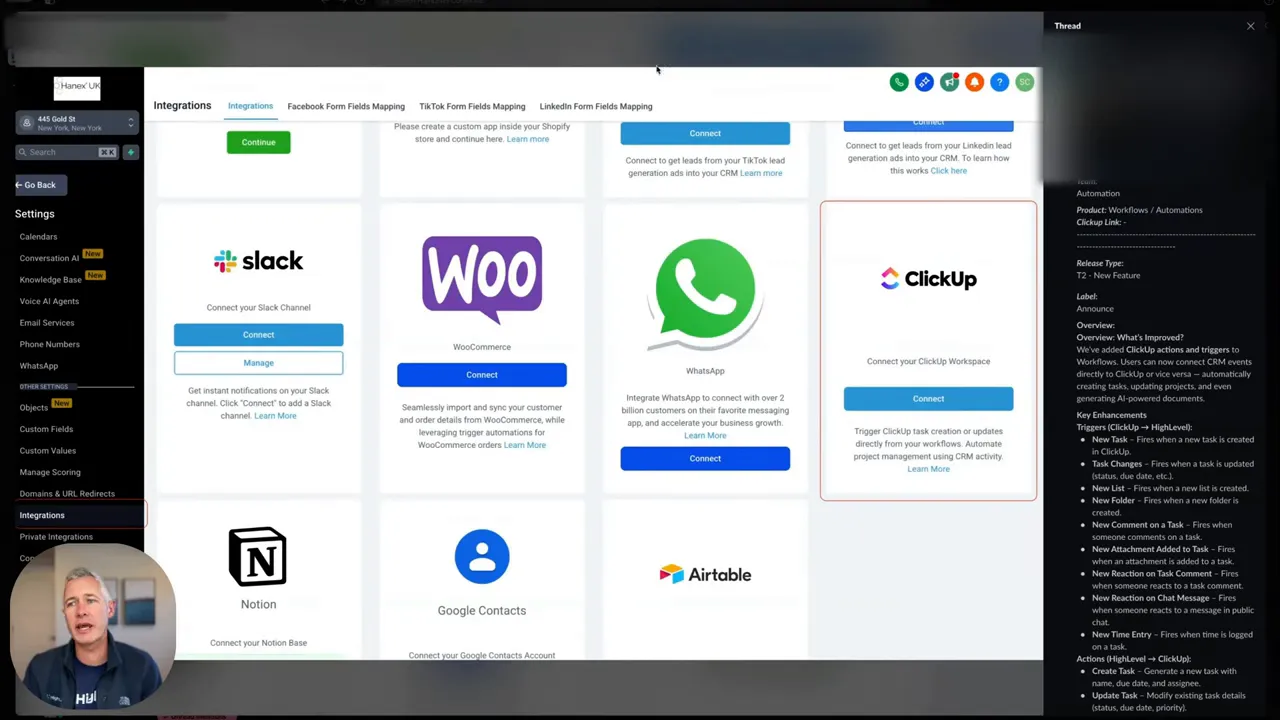
In my recent product update I announced a new integration that demonstrates how critical smooth connections are to workflows: “ClickUp integration is live in workflows, both actions and triggers,” I said — a short statement that shows the power of integrations to unlock automation and remove friction.
Sean: "ClickUp integration is live in workflows, both actions and triggers."
Here’s why that matters for building top-performing marketing funnels: integrations let you trigger CRM updates, create tasks for fulfillment teams, send personalized follow-ups, and capture behavioral signals for optimization — all automatically. When your marketing funnels are plugged into a cohesive platform, conversion steps become measurable, repeatable, and scalable.
Over the next several sections we’ll dig into the primary themes this product moment highlights — automation, integrations, simplicity, analytics, and community — and then show how GFunnel maps those themes into practical features that drive outcomes like higher conversion rates, reduced manual work, faster creative iteration (thanks to fast autosave), and stronger networks.
Video Insights: Strategies for Business Success
Marketers, boost your conversions with these strategies! From a short product update about a new integration, several strategic themes emerge that are vital to entrepreneurs and marketing teams building effective marketing funnels. Below I extract and expand on those themes so you can apply them directly to your business.
Theme 1 — Integrations and Workflow Automation
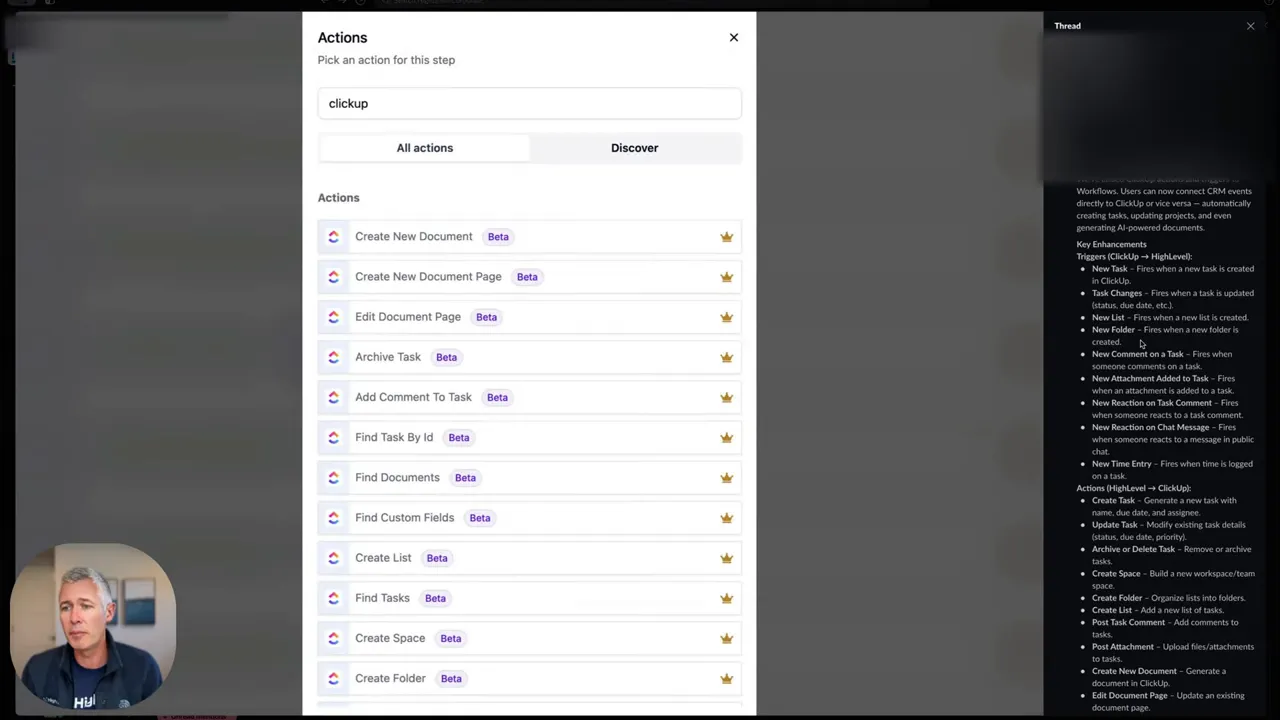
The announcement centered on a single, powerful message: plug tools together and automate the work. Integrations like ClickUp appearing as both actions and triggers in workflows allow teams to automate cross‑platform processes. This reduces manual handoffs, speeds execution, and ensures consistency across the funnel stages — from lead capture to delivery.
Why it’s essential for marketing funnels:
- You can automatically move leads from ad click to landing page to CRM and then to a follow-up sequence without manual input.
- Triggers enable behavior-driven campaigns: if a prospect opens an email three times, create a task for a sales rep and send a short-text nudge.
- Actions allow you to create tasks, update statuses, or spin up fulfillment processes as soon as a conversion happens, improving response time and customer experience.
Theme 2 — Simplicity and Rapid Onboarding
One line from my message encapsulated this theme: “As always, just go over the integration section and integrate it. And bada bing bada boom, you are good to go.” Simplicity matters because tools that are too complex never get used. For marketing funnels to be effective, the underlying systems must be intuitive so non‑technical team members can maintain and iterate on campaigns.
Theme 3 — Triggers, Actions, and Event‑Driven Workflows
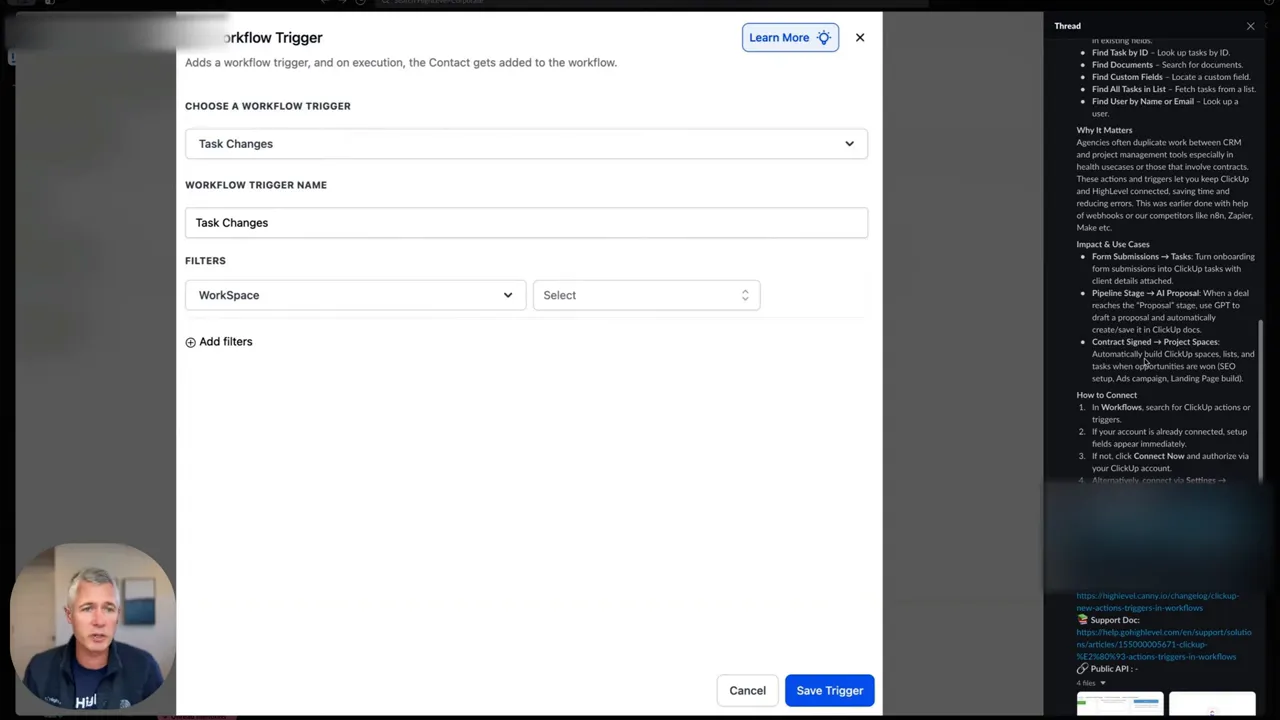
When I mentioned “there are a lot of actions that you can do here … on the right hand side you can see all the triggers — new tasks, task change etc,” I was pointing to the critical architecture of effective funnels: event-driven workflows. These workflows respond in real time to user or system events and are the lifeblood of personalization and scaling.
Sean: "There are a lot of actions that you can do here … and on the right hand side you can see all the triggers — new tasks, task change etc."
Event-driven workflows allow marketers to customize paths within the funnel, automatically segment audiences, and optimize based on real, time‑stamped behavior.
Theme 4 — Speed, Reliability, and Product Momentum
Announcements like this are also a trust signal. Saying “this is live in the system so when you get a chance go check it out” tells the audience the product is mature, maintained, and supported. Momentum and speed — both in the product development lifecycle and within operational tasks — are necessary to keep marketing funnels performing over time.
Theme 5 — Team Culture and Continuous Improvement
Close with gratitude: “Again, huge props to the team for making this happen.” This reminds us that building great funnels and platforms comes from focused teams. The culture that supports product updates, rapid iteration, and community feedback is a theme every entrepreneur should prioritize when choosing a platform partner.
Key takeaways
- Integrations are not optional — they are foundational for modern marketing funnels.
- Simplicity and ease of use accelerate adoption and reduce friction for non‑technical teams.
- Event-driven triggers and actions enable personalization and speed.
- Fast and reliable infrastructure supports experimentation and performance.
- Teams and community momentum are decisive for long‑term success.
GFunnel’s Ecosystem Solutions
Small business owners, scale smarter with GFunnel! Now let’s map each of the themes above directly to GFunnel features so you can see how to execute on these strategies for your business. For every theme I’ll outline the GFunnel capability, the expected business outcome, and a quick stat or performance metric to guide expectations.
GFunnel’s Integration & Automation for Workflow Efficiency
GFunnel connects marketing funnels directly to a robust automation engine and CRM integration (Lead Connector). This linkage allows behavior triggered campaigns, automated task creation, and seamless data flow between systems. When a lead completes a funnel step, GFunnel can automatically update contact records, notify teams, and trigger follow‑up sequences.
Business outcomes:
- Reduced manual work by up to 50% through automated workflows and CRM integration.
- Faster lead response times, improving conversion rates by an expected 10–20% when handoffs are timely.
- Consistent data across marketing and operations, reducing missed leads.
Stat: 50% less manual work with automation and Lead Connector syncing (hypothetical benchmark from GFunnel feature descriptions).
Action you can take right now: define the top three manual tasks in your funnel and configure GFunnel workflows to automate them. Examples: lead assignment, invoicing, or onboarding email sequences.
CTA: Explore GFunnel’s automation features at: https://www.gfunnel.com/automation-home
GFunnel’s Simplicity: Drag‑and‑Drop Funnels and Fast Editing
GFunnel’s visual funnel builder removes friction from campaign creation. Non‑technical marketers can assemble landing pages, forms, email sequences, and payment collection in one environment. And critically, GFunnel’s web worker autosave reduces lost work and speeds up iteration.
Performance highlight:
- Fast autosave: 103ms save time via web worker (from 2.861s to 103ms), which is roughly 28x faster than legacy editors — this keeps teams focused and reduces rework.
- Immediate previews and drag‑and‑drop templates speed up funnel launches by days, not weeks.
Stat: 28x faster autosave (2.861s → 103ms) for uninterrupted creative flow.
Action: Use GFunnel’s drag‑and‑drop funnel builder to prototype three funnel variations and deploy the fastest converting one within a week.
CTA: Build your first funnel at: https://www.gfunnel.com/funnel-home
GFunnel’s Event‑Driven Triggers & Lead Connector With GFunnel
Event-driven automation drives personalization. GFunnel includes triggers based on page visits, form completions, purchase events, and custom attributes. Pair that with the Lead Connector With GFunnel CRM integration, and you can route leads based on behavior, segment audiences, and create personalized follow-ups at scale.
Business outcomes:
- Higher relevancy in follow-up messages increases engagement — test flows often show 15–20% lift in open or click rates when behavior is used for segmentation.
- Reduced sales cycle times by creating immediate notifications and assigning leads to appropriate reps.
Stat: 20% conversion boost with automation-based nurturing sequences (industry benchmark, illustrative).
Action: Implement three event-driven rules: abandon cart reminder, high-intent lead alert, and VIP customer upsell trigger.
CTA: Learn about Lead Connector and CRM tools at: https://www.gfunnel.com/crm
GFunnel’s Real‑Time Analytics and Optimization
Tracking is only useful when it’s real time. GFunnel provides dashboards that show funnel performance, conversion rates, drop-off points, and revenue attribution so you can iterate quickly. These insights let you A/B test elements of the funnel and allocate budget to the best performing channels.
Business outcomes:
- Faster decision cycles from real-time data — pivot campaigns mid-week rather than waiting for monthly reports.
- Better ROI allocation because you can measure funnel stage performance and reassign spend where it matters.
Stat: Expect a 10–15% improvement in campaign ROI when using real-time analytics for weekly optimization (illustrative).
Action: Set up a dashboard to monitor landing page conversion, email sequence dropoff, and payment flow metrics.
CTA: Check out GFunnel’s analytics capabilities at: https://www.gfunnel.com
GFunnel’s Business Networking and Community Features
Marketing funnels don’t exist in a vacuum. GFunnel’s communities bring entrepreneurs and peers together for feedback, mentorship, and partnership. Use community input to test messaging, discover niche audiences, and recruit collaborators for joint campaigns.
Business outcomes:
- Access to niche communities (e.g., E-commerce Pros, SaaS Founders) that reduce go‑to‑market friction.
- Faster learning curves and best-practice sharing that can shorten experimentation cycles.
Stat: Niche communities increase lead referrals and collaborative growth opportunities by an estimated 15% annually (illustrative benefit).
Action: Join a relevant GFunnel community and post a funnel test plan to get feedback before broad Launch.
CTA: Join GFunnel’s networking tools at: https://www.gfunnel.com/communities
GFunnel’s E‑commerce Tools and Payments
For businesses selling products or services, GFunnel includes e‑commerce payments that integrate directly into your funnels. That means fewer redirects, simpler checkout flows, and better conversion continuity.
Business outcomes:
- Simpler payment flow yields higher conversion rates — integrated payment checkouts reduce friction during the decision stage.
- Order and customer data automatically sync back into CRM and fulfillment workflows for improved operations.
Stat: Integrated checkout can reduce cart abandonment by 10–20% depending on funnel complexity.
Action: Use GFunnel’s built-in payments to run a direct-to-consumer funnel with one-click receipts and automated fulfillment tasks.
CTA: Start with GFunnel’s e‑commerce features at: https://www.gfunnel.com/explore
Real‑World Applications: Case Studies
Small business owners, apply these blueprints to your own business. Below are two case studies — an e‑commerce store and a local restaurant — showing how marketing funnels and GFunnel’s ecosystem solve real challenges.
Case Study 1: The Niche E‑Commerce Store
Scenario: An owner of an online specialty tea shop wants to grow repeat purchases and improve conversion rates from social ads. They had multiple tools: a landing page builder, separate CRM, email provider, and a project management tool. The manual work of copying customer info between systems and manually alerting the fulfillment team led to delays and lost revenue.
Challenges:
- Fragmented systems caused data duplication and slow fulfillment.
- Limited personalization for returning customers.
- Design bottlenecks: lost drafts and slow autosave hampered rapid A/B testing.
GFunnel solution:
- Consolidate landing pages, checkout, CRM, and email sequences inside GFunnel.
- Use event triggers to segment returning customers and apply personalized offers.
- Employ the 103ms autosave to let the creative team iterate quickly on landing page variants.
- Automate fulfillment tasks via workflow actions to the store’s task management system (Lead Connector With GFunnel syncs order data to fulfillment tasks).
Results (hypothetical, based on GFunnel capabilities):
- Conversion rate improved by 18% after implementing integrated checkout and targeted retargeting emails.
- Fulfillment delays reduced by 60% thanks to automated task creation and updates.
- Design iteration cycles shortened, leading to faster optimization and a 12% uplift in clicks-to-conversion.
"GFunnel’s automation saved us hours weekly and finally gave us a single source of truth for our customers." — E‑commerce owner
Long‑tail keywords used: build marketing funnels with GFunnel, best business platform for entrepreneurs, automate business operations with GFunnel.
Case Study 2: Local Restaurant Chain
Scenario: A multi-location restaurant wanted to increase online orders, streamline reservations, and improve customer loyalty. They used separate point-of-sale systems and an external promotions tool. Marketing campaigns lacked real-time feedback and required manual reconciliation across systems.
Challenges:
- Complexity of multi-location promotions and inconsistent customer records.
- Manual labor in reconciling promotional redemptions and special offers.
- Slow campaign iteration due to risk of losing in-progress creative work.
GFunnel solution:
- Use GFunnel’s restaurant ecosystem and payment processing to centralize online ordering and promotions.
- Capture customer data at checkout (Call Net Capture) and feed it into Lead Connector With GFunnel CRM for loyalty segmentation.
- Create event-driven triggers: when a customer orders twice in 30 days, trigger a VIP offer or automated SMS reminder for upsell.
- Leverage communities to test seasonal campaign ideas with peers in the restaurant space before deploying broadly.
Results (hypothetical):
- Online order volume increased by 25% after centralizing promotions and payments.
- Loyalty engagement improved with automated VIP offers — a 30% increase in repeat orders among targeted customers.
- Reduced operational friction by automating table or delivery task creation for staff, saving 10 hours weekly.
"GFunnel’s communities doubled our sales! Getting feedback from other restaurant owners helped us fine-tune our seasonal promotions." — Multi-location restaurant manager
Long‑tail keywords used: Scale Restaurants with GFunnel, networking for small businesses, automated restaurant ordering with GFunnel.
Why GFunnel Leads
Small business owners, choose a platform that grows with your needs. GFunnel leads when compared to traditional stacks because it combines funnels, CRM, automation, community, and payments into a single platform — eliminating costly integrations, tool sprawl, and the mistakes that cost conversion rate and time. Below I break down major advantages and how they translate into measurable business benefits.
Core differentiators
- All‑in‑one: Funnels, CRM (Lead Connector With GFunnel), automation, payments, and communities in one place.
- Speed: 103ms autosave keeps the creative flow intact so teams experiment more frequently.
- Real‑time analytics: immediate visibility into funnel performance and spend efficiency.
- Community and mentorship: niche groups that accelerate learning and open partnership opportunities.
- Cost efficiency: fewer point tools and fewer integration costs — more predictable pricing and value.
Traditional Business Tools vs. GFunnel’s Ecosystem
Below is a comparison presented as structured bullet rows to illustrate differences and outcomes:
Autosave Speed
- Traditional Methods: Slow (seconds) — lost edits and interruptions.
- GFunnel: Fast (103ms, 28x faster) — continuous saving via web worker, faster iteration.
Automation
- Traditional Methods: Manual processes, manual handoffs across tools.
- GFunnel: 50% less manual work through integrated workflows and Lead Connector automation.
Networking
- Traditional Methods: Limited connections, ad hoc communities.
- GFunnel: Niche communities for entrepreneurs, e‑commerce, SaaS, and restaurants to collaborate and learn.
Analytics
- Traditional Methods: Third‑party tools with delayed reporting and fragmented views.
- GFunnel: Real‑time dashboards with unified attribution and funnel analytics.
Tailored Solutions
- Traditional Methods: Generic tools requiring complex integration and maintenance.
- GFunnel: Tailored ecosystems (e.g., restaurant ordering, e‑commerce payments) built to map to real business flows.
These differences matter because they reduce friction at every step of the funnel, increase the speed of iteration, and ensure business operations scale without proportionally increasing overhead.
Additional Tools and Community Calls
GFunnel’s ecosystem is also designed to be extensible: if your business requires additional integrations, GFunnel provides APIs and connectors. You can also leverage the platform’s courses and events to quickly train staff on new funnel strategies or tap into group discussions for creative ideas.
Suggested actions:
- Join a GFunnel community aligned with your niche to round out your strategy: https://www.gfunnel.com/communities
- Create an account and test a small funnel: https://www.gfunnel.com/create-account
- Explore automation templates and best practices: https://www.gfunnel.com/automation-home
- See pricing and plan options that fit your stage: check the site explore and create-account pages for plan details.
Interactive Engagement and Next Steps
To keep readers engaged, try a short self-assessment to identify the highest-impact improvements for your funnels. Consider a quick quiz called “Test Your Business Growth Potential” — evaluate automation gaps, funnel friction points, and community participation. (Create the quiz inside GFunnel and share it across your community channels.)
Community Call: Connect with E-commerce Pros! Share your funnel link, ask for conversion feedback, and iterate faster with peer reviews.
Conclusion and CTA
Entrepreneurs, ready to transform your business? The product announcement that inspired this article highlighted one of the most important truths for modern marketing funnels: integrations and automation unlock growth. GFunnel turns that principle into practice by combining marketing funnels, Lead Connector With GFunnel CRM sync, automation, real‑time analytics, payments, and community into a unified platform designed for scaling businesses.
Use GFunnel to reduce manual labor, speed up funnel iteration with fast autosave, and leverage community insights to optimize your campaigns. Whether you’re an e‑commerce founder looking to increase repeat purchases, a restaurant owner streamlining orders and promotions, or a marketer seeking to build sophisticated workflows without relying on dozens of tools, GFunnel provides a practical path forward.
Get started: Create your account and build your first funnel, or explore community resources to refine your approach: https://www.gfunnel.com/create-account
FAQs
- How does GFunnel support marketing funnels?
GFunnel provides an integrated funnel builder, CRM integration (Lead Connector With GFunnel), automated workflows, and real‑time analytics — all aimed at simplifying how you capture, nurture, and convert leads.
- What makes GFunnel more than a funnel builder?
GFunnel combines funnels with CRM, automation, payments, and niche communities so you get a unified business platform instead of disjointed point tools.
- How does GFunnel reduce manual work?
By using event-driven triggers, automated actions, and CRM syncs, GFunnel can reduce repetitive tasks by up to 50%, such as lead routing, fulfillment task creation, and follow-up messaging.
- What is GFunnel’s autosave benefit?
GFunnel uses a web worker to autosave work in about 103ms, dramatically cutting the risk of lost edits and enabling faster creative iteration compared to editors that save in seconds.
- Can I join communities on GFunnel to improve my funnels?
Yes. GFunnel hosts niche communities where you can get feedback, mentorship, and collaboration opportunities. These communities are especially useful for testing messaging and promotional strategies.
Related Topics & Resources
- Scale Restaurants with GFunnel — https://www.gfunnel.com/explore
- GFunnel’s networking tools — https://www.gfunnel.com/communities
- Build marketing funnels with GFunnel — https://www.gfunnel.com/funnel-home
Final Notes
Remember: great marketing funnels are built on repeatable systems. Integrations and automation — exemplified by the ClickUp-style workflow integration I announced — are necessary but only one part of the equation. Combining integrations with real‑time analytics, streamlined creative workflows (fast autosave), and strong community feedback creates a robust engine for growth. GFunnel brings these components together into an actionable, easy‑to‑adopt platform for entrepreneurs and marketers.
Thanks for reading — and if you’re ready to begin, start building your first funnel in GFunnel and connect it to your CRM and automation workflows today: https://www.gfunnel.com/create-account
Need Help Implementing This? |
|
Schedule A Discovery Call With One Of Our Professionals |
| Access Now |


