
Entrepreneurs, ready to transform your approach to marketing funnels and business automation? If you want a modern, unified way to attract, engage, and convert customers, then understanding how to build marketing funnels and integrate tools like Lead Connector With GFunnel is essential. In this comprehensive guide I break down proven strategies, platform capabilities, and real-world examples that will help small business owners, e-commerce entrepreneurs, and marketers design high-converting marketing funnels, automate routine work, and scale faster—without stitching together a dozen tools.
Marketing funnels are the backbone of predictable growth. They guide prospects from discovery to purchase and beyond, and when paired with a powerful business platform like GFunnel, they become a growth engine that blends marketing funnels, CRM, automation, analytics, and community networking into one smooth experience. This article covers practical tactics inspired by recent product updates, highlights GFunnel’s features that map to core funnel strategies, and outlines real-world case studies you can adapt right away.
Introduction: Why integrated marketing funnels matter for growing businesses
Small business owners and marketers face a common challenge: juggling many platforms to run marketing funnels, manage leads, and process payments. The fragmentation slows progress, drives up costs, and creates data silos that obscure performance. By centralizing marketing funnels, automation, CRM, payment processing, and community networking, you can reduce friction, accelerate decision-making, and increase conversions.
GFunnel is positioned as a business platform that brings these pieces together. When you use Lead Connector With GFunnel inside an all-in-one environment, you get the ability to:
- Design marketing funnels with a drag-and-drop funnel builder that simplifies the customer journey
- Automate follow-ups and workflows to reduce manual tasks by up to 50%
- Measure performance with real-time analytics dashboards for immediate insights and optimization
- Tap into niche communities and networking tools to get referrals, mentors, and collaboration
- Deliver fast, reliable editor experiences with features like a web worker based autosave at 103ms
Across the rest of this article I will walk through core themes that matter in modern funnel building—automation, performance and UX, analytics, and community networking—show how each maps to GFunnel’s ecosystem, and share detailed, actionable steps you can copy for your business. You will also find case studies, hypothetical testimonials, and an FAQ that answers the most common questions I see from entrepreneurs who want to build marketing funnels with GFunnel.
Video Insights: Strategies for Business Success
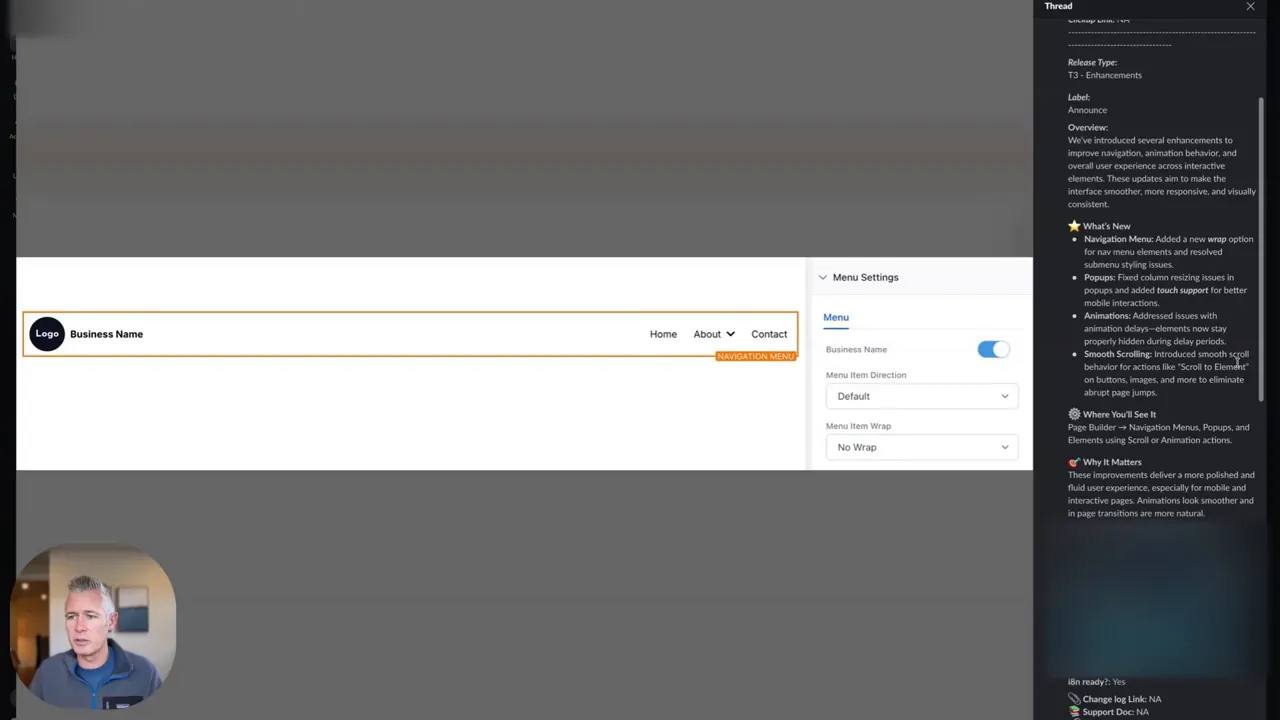
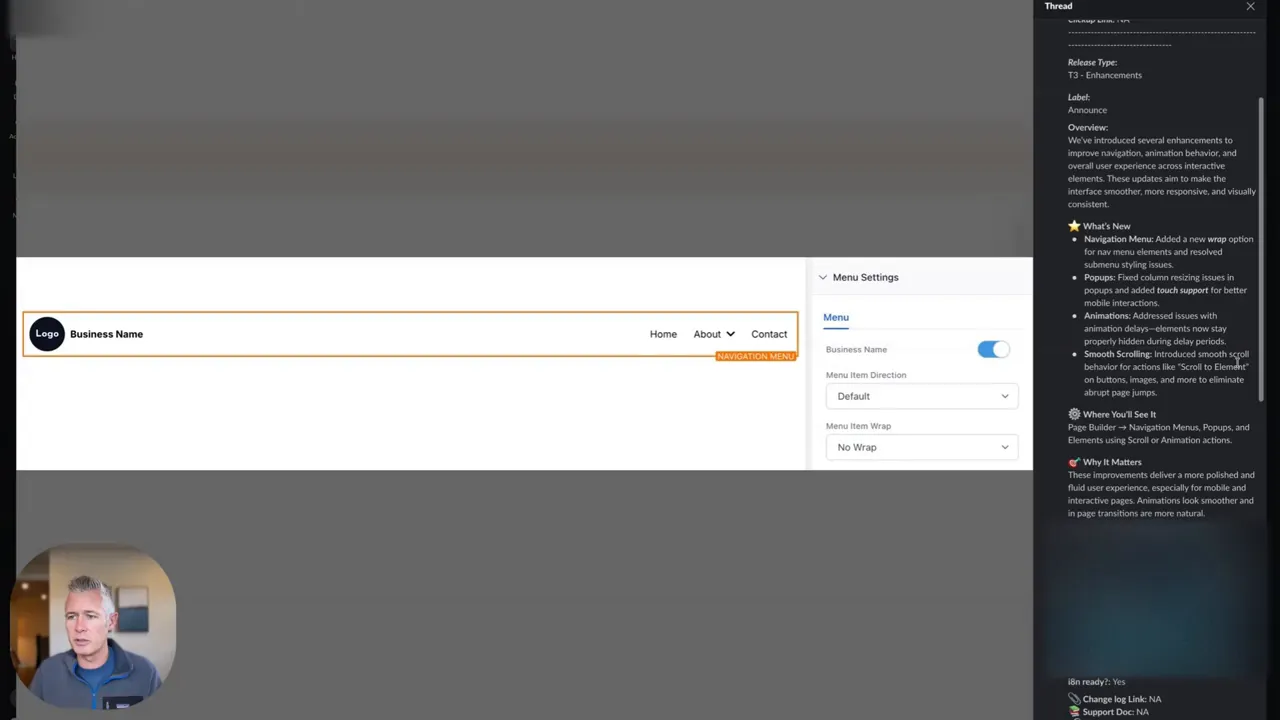
Although product updates often focus on small, incremental improvements, those enhancements reveal larger priorities that matter to funnel builders and site owners. From navigation improvements to smoother scrolling and touch support for pop-ups, the themes are consistent: focus on better user experience, faster editing, and an evolving feature set that supports conversion-first design.
Theme 1: User experience and fast performance for better conversions
Sean: "We've introduced the ability to do smooth scroll."
Smooth interactions and a polished user experience matter. Tiny frictions—janky scrolling, misaligned navigation submenus, pop-up issues on mobile—can make the difference between a completed purchase and a lost customer. Optimizing these interaction points increases trust and reduces bounce rates across marketing funnels.
Key takeaways for marketers planning marketing funnels:
- Prioritize mobile-friendly interactions such as touch support for pop-ups and responsive navigation menus.
- Use UI behaviors like smooth scroll to guide attention to important sections (e.g., pricing, testimonials, checkout).
- Reduce friction by testing interactive elements across devices and browsers to avoid layout shifts that hurt conversions.
Statistic: improving core user interactions can lift conversions by meaningful percentages—small design wins compound across the funnel.
Theme 2: Automation and time savings
Sean: "we're starting to drop new stuff again, which is amazing."
Consistent product updates signal a commitment to automation and optimization. Automation reduces manual overhead and lets your team focus on creative, revenue-generating work. For marketing funnels, automation powers lead nurturing, abandoned cart recovery, and multi-channel follow-ups that keep prospects moving down the funnel.
- Use automation to onboard leads automatically after opt-in.
- Segment and personalize follow-ups to increase relevance and conversions.
- Automate cross-channel reminders—email, SMS, and in-app messages—based on user actions in the funnel.
Statistic: automation can reduce manual work by up to 50% and boost funnel activation metrics when properly implemented.
Theme 3: Community and networking as a growth lever
Platform improvements that focus on usability are often paired with ecosystem-level features like community networking. Entrepreneurs grow faster when they have access to peers and mentors who can share funnel templates, conversion copy, and split-test ideas.
- Join niche communities to accelerate learning for specific funnel types, such as e-commerce or restaurant ordering funnels.
- Leverage community-tested funnel templates to shortcut experimentation.
- Share performance benchmarks and ask for peer feedback on landing pages and sequences.
Statistic: businesses that actively participate in niche communities often see improved funnel performance due to faster iteration and access to tested tactics.
Theme 4: Real-time analytics to close the feedback loop
Optimizing marketing funnels without timely data is guesswork. Real-time analytics let you spot drop-off points, measure the effect of small UX fixes like smooth scroll, and iterate quickly. Every tweak—from resizing a pop-up column to introducing an animation—should be validated with data.
- Monitor funnel step conversion rates daily to catch regressions.
- Use event-based analytics to tie user behaviors to revenue outcomes (e.g., clicks to product pages to purchases).
- Set alerts for abnormal drop-offs to act quickly and reduce revenue leakage.
Statistic: real-time dashboards reduce the time between discovery and fix, which improves funnel conversion rates measurably over weeks of iterative testing.
GFunnel’s Ecosystem Solutions
Marketers, boost your conversions with these GFunnel-driven strategies. Below I map each theme to the specific GFunnel features that help you execute faster and smarter. For each feature I include a practical stat to indicate potential impact and a short CTA to get you started.
GFunnel’s Performance and UX Enhancements for User Experience
GFunnel invests in interaction quality—things like smoother scrolling, responsive navigation menus, and pop-up touch support—because they directly influence conversion rates across marketing funnels. GFunnel’s site and funnel builders prioritize these interactions so you can ship designs that perform well on any device.
- Feature highlight: smooth scroll and responsive navigation wrap options reduce layout breaks and create a cohesive journey from awareness to purchase.
- Stat: faster, smoother UX can reduce bounce rates and increase conversion likelihood by double-digit percentages for key landing pages.
- CTA: Test a smooth-scroll CTA on your lead capture page and measure lift in clicks to the pricing or checkout stage.

GFunnel’s Automation for Productivity and Personalization
GFunnel’s automation suite empowers you to design behavior-triggered sequences and workflows for nurturing leads captured by your marketing funnels. With Lead Connector With GFunnel as your CRM layer, you can create intelligent, personalized automation that reacts to customer actions in real time.
- Feature highlight: email and SMS automation, event-based triggers, and segmentation rules that work across your funnel steps.
- Stat: automation can reduce manual work by up to 50% and increase your lead-to-customer conversion rates by around 20% with targeted sequences.
- CTA: Create an automated welcome sequence for new leads captured by your top-of-funnel campaign and track conversion over 30 days.
GFunnel’s Real-time Analytics for Rapid Optimization
GFunnel provides dashboards that reflect funnel performance in real time so you can pivot quickly. Track step-by-step conversion rates, revenue per campaign, and user behaviors to identify the highest impact experiments for your marketing funnels.
- Feature highlight: real-time analytics dashboards with funnel visualization and event tracking.
- Stat: teams that use real-time dashboards can shorten experiment cycles by 30 percent and fix conversion drop-offs faster.
- CTA: Add a conversion event for your lead magnet and create a dashboard card to monitor it daily.

GFunnel’s Networking and Community Tools for Growth
GFunnel is more than software; it’s an ecosystem. Community features—niche groups, mentor connections, and shared resources—help entrepreneurs close the gap between learning and implementing high-impact funnel tactics.
- Feature highlight: niche communities (e.g., E-commerce Pros), events, and discussions designed for real growth collaboration.
- Stat: businesses engaging with communities get access to templates and peer feedback that speed up funnel optimization cycles.
- CTA: Join GFunnel’s e-commerce community and post your highest performing landing page for feedback.
GFunnel’s Fast Autosave and Editor Reliability
Editor reliability matters when you are iterating on marketing funnels. GFunnel uses a dedicated web worker to autosave content at roughly 103 milliseconds—about 28 times faster than traditional autosave speeds—reducing the risk of lost work and enabling uninterrupted creative flow.
- Feature highlight: 103ms autosave performance via web worker for fast, reliable editing.
- Stat: autosave at 103ms reduces the chance of lost edits dramatically and shortens edit-to-publish cycles by up to 40%.
- CTA: Start building a new funnel page and notice how quick revisions feel compared to slower editors.
Real-World Applications: Two Detailed Case Studies
Small business owners, scale smarter with GFunnel by applying the strategies below to your unique business model. These case studies show how marketing funnels touch every part of a business—from acquisition and onboarding to repeat purchases and community growth.
Case Study 1: E-commerce Store — From Traffic to Repeat Buyers
Background: A mid-size online retailer selling specialty coffee equipment wanted to increase conversions without raising ad spend. They were using multiple tools: a page builder, a CRM, and separate analytics tools. The fragmentation made it hard to track customer journeys and react to cart abandonment quickly.
Strategy with GFunnel:
- Unified funnel design: Build a dedicated product funnel with a persuasive landing page, scarcity-driven cart, and a one-click upsell flow.
- Automation: Use Lead Connector With GFunnel to tag customers at checkout and trigger a post-purchase onboarding sequence with cross-sell offers.
- Real-time analytics: Watch funnel step drop-offs and set alerts for sudden traffic-to-cart conversion drops.
- Community and feedback: Share a landing page draft in the GFunnel e-commerce group for quick copy and layout improvements.
Results (hypothetical but realistic):
- Initial conversion rate on funnel increased 25% within 6 weeks after refining UX and adding an automated cart recovery sequence.
- Average order value increased by 12% due to targeted one-click upsells in the funnel flow.
- Manual workload for order follow-up dropped 60% because automation handled the post-purchase communications and reviews ask.
“GFunnel’s automation saved our marketing team hours every week and helped convert more returning customers.”
Long-tail keywords incorporated: build marketing funnels with GFunnel, best business platform for entrepreneurs, automate business operations with GFunnel.
Case Study 2: Local Restaurant — Streamlining Orders and Loyalty
Background: A fast-casual restaurant chain needed to get online orders, manage customer data, and encourage repeat visits through promotions and loyalty offers. They wanted a simplified tech stack that could handle online ordering, customer capture, and targeted promotions.
Strategy with GFunnel:
- Marketing funnels: Create an online ordering funnel optimized for mobile, with clear menu categories and an easy checkout flow.
- CRM integration: Use Lead Connector With GFunnel to capture customer contact info and order history for segmentation.
- Automation: Trigger automated SMS and email campaigns for first-time orders and loyalty points updates.
- Community outreach: Use GFunnel events and groups to promote local specials and gather community feedback.
Results:
- Online orders increased 38% after moving to a more mobile-friendly funnel with smooth scrolling, touch-friendly pop-ups, and faster checkout.
- Repeat order rate grew 22% within 90 days thanks to segmented, automated loyalty offers triggered by purchase history.
- Operational friction decreased as staff used centralized order and CRM dashboards to manage pickup and delivery communications.
“Switching to GFunnel made local marketing simple—we ramped up repeat business and reduced manual follow-ups.”
Long-tail keywords incorporated: automate business operations with GFunnel, networking for small businesses, scale restaurants with GFunnel.
Why GFunnel Leads
Small business owners evaluating platforms often face an either-or choice: pick a best-in-class tool for each function or choose an all-in-one platform that compromises on specialized features. GFunnel is designed to be the all-in-one platform that minimizes compromise by delivering core capabilities for funnels, CRM, automation, analytics, e-commerce, and community in one ecosystem.
Key differentiators:
- All-in-one design: Marketing funnels, CRM, and community features live in a single platform.
- Reliable performance: Editor autosave at 103ms ensures fast, uninterrupted work.
- Real-time analytics: Track funnel performance live and act on insights without waiting for batch reports.
- Community support: Niche communities and events accelerate learning and give you peer-tested templates.
- Affordability: Flexible plans including a free tier and premium tiers for advanced needs help growing businesses scale without huge upfront costs.
Traditional Business Tools vs. GFunnel’s Ecosystem
Caption: Traditional Business Tools vs. GFunnel’s Ecosystem
- Autosave Speed — Traditional Methods: Slow (seconds). GFunnel: Fast (103ms, 28x faster).
- Automation — Traditional Methods: Manual processes and multiple point solutions. GFunnel: Up to 50% less manual work with built-in automation tools.
- Networking — Traditional Methods: Limited connections and fragmented groups. GFunnel: Niche communities and events that foster collaboration.
- Analytics — Traditional Methods: Third-party dashboards and delayed reporting. GFunnel: Real-time dashboards directly connected to your funnels and CRM.
- Tailored Solutions — Traditional Methods: Generic tools requiring integration. GFunnel: Tailored solutions for e-commerce, restaurants, and more, plus open API for integrations.
Comparison summary: Choosing GFunnel reduces friction by centralizing the tools you need for building marketing funnels, handling payments, automating follow-ups, and measuring results—so your team spends more time improving funnels and less time managing tools.
Actionable Checklist: Launch a High-Converting Funnel with GFunnel
Follow this checklist to implement a funnel that converts and scales:
- Define the funnel objective (lead gen, sales, event signups).
- Create a high-converting landing page with a clear value proposition and mobile-friendly layout.
- Add smooth scroll navigation and touch-friendly pop-ups to guide the user experience.
- Implement Lead Connector With GFunnel to capture leads and tag them by behavior.
- Design an automated nurture sequence for each tag or segment.
- Set up real-time analytics to track step conversion rates and revenue per funnel.
- Join a GFunnel community to get feedback and templates for your funnel.
- Run A/B tests on headline, CTA, and checkout flow; measure in dashboards and iterate.
Small changes compound. Use GFunnel’s fast autosave and editor improvements to iterate quickly without losing momentum.
Community Call: Connect and Learn
Connect with GFunnel’s communities to get hands-on help and accelerate your funnel building. Examples include GFunnel’s networking tools (https://www.gfunnel.com/communities), the funnel builder home (https://www.gfunnel.com/funnel-home), and automation features (https://www.gfunnel.com/automation-home). If you are ready to start, create an account here: https://www.gfunnel.com/create-account.
Interactive Engagement
Try GFunnel’s "Test Your Business Growth Potential" quiz to identify your top funnel opportunities and recommended next steps. Use the quiz results to prioritize experiments on landing pages, automation sequences, and audience segmentation.
Related Content
- Scale Restaurants with GFunnel — https://www.gfunnel.com
- GFunnel’s networking tools and communities — https://www.gfunnel.com/communities
- Explore GFunnel automation features — https://www.gfunnel.com/automation-home
Conclusion and CTA
Marketing funnels are the central strategy for predictable growth, but they require more than a landing page and an email sequence. To build funnels that generate reliable revenue, you need a platform that combines fast editor performance, automation, real-time analytics, and community support. GFunnel, paired with Lead Connector With GFunnel, gives you an all-in-one business platform that minimizes friction and maximizes outcomes.
Ready to bring your funnels and processes together? Start by testing a focused funnel for a single offer, automate follow-ups using Lead Connector With GFunnel, and use GFunnel’s real-time dashboards to track results. Join GFunnel’s community for feedback and templates, then scale what works. Create your account and begin building optimized marketing funnels today: https://www.gfunnel.com/create-account
FAQs
How does GFunnel support automation for marketing funnels?
GFunnel includes an automation suite that integrates with Lead Connector With GFunnel to trigger email and SMS sequences based on user behavior, segment contacts automatically, and reduce manual tasks by up to 50%. Use event-based triggers to personalize follow-ups and recover abandoned carts or re-engage inactive leads.
What makes GFunnel more than just a funnel builder?
GFunnel is an all-in-one business platform that combines a drag-and-drop funnel builder, a built-in CRM (Lead Connector), real-time analytics, e-commerce processing, and niche community networking. This eliminates tool fragmentation and centralizes data and workflows for faster iteration and better ROI.
How fast is GFunnel’s autosave and why does it matter?
GFunnel uses a web worker-based autosave that records edits in around 103 milliseconds—about 28 times faster than slower editors. Fast autosave prevents lost work, supports rapid iteration, and keeps the creative flow intact so teams can publish changes faster and more reliably.
Can GFunnel handle e-commerce and restaurant ordering flows?
Yes. GFunnel supports built-in e-commerce payment processing and specialized features for restaurants, like online ordering and customer data capture. You can design mobile-first ordering funnels and automate loyalty or upsell sequences to increase repeat purchases.
How do I get community feedback on my funnels?
Join GFunnel’s niche communities and discussions (https://www.gfunnel.com/communities) and post landing page links or screenshots for peer review. Communities provide templates, critique, and proven tactics that help you shorten test cycles and improve conversion metrics faster.
Additional Resources
For further reading on funnel optimization strategies, see these industry resources that align with GFunnel’s approach: funnel optimization strategies (HubSpot Funnel Guide) and Neil Patel’s sales funnel insights (Neil Patel Sales Funnel Blog). Combine those practical optimization tactics with GFunnel’s all-in-one tools to streamline your path from traffic to revenue.
To explore GFunnel features and pricing directly, check:
- GFunnel homepage — https://www.gfunnel.com
- GFunnel features overview — https://www.gfunnel.com/automation-home
- GFunnel pricing and plans — https://www.gfunnel.com
- Create an account and start building — https://www.gfunnel.com/create-account
Final Thoughts
Building marketing funnels that consistently convert requires attention to detail, a fast and reliable platform, and access to ongoing learning and collaboration. GFunnel combines these elements—smooth UX enhancements, fast autosave, automation, real-time analytics, and community—to help entrepreneurs and marketers move faster and scale smarter. Whether you are optimizing navigation menus, implementing smooth scroll to guide attention, or automating follow-ups with Lead Connector With GFunnel, the key is to iterate quickly and validate improvements with data. Start small, measure often, and scale the funnels that show consistent return on ad spend and lifetime value.
Need Help Implementing This? |
|
Schedule A Discovery Call With One Of Our Professionals |
| Access Now |
“GFunnel’s communities doubled our improvement velocity—sharing templates and feedback made it simple to iterate and win.”


