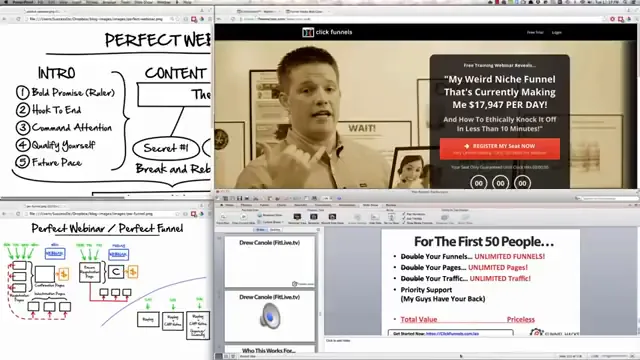
Russell Brunson’s Perfect Webinar framework is not a secret—it's a system. Over the years I’ve taught this process to thousands of entrepreneurs, consultants, coaches, and companies because it works. In this guide I’ll walk you step-by-step through the exact structure I use: why your opening matters, how to design the content so it primes the sale, how to identify and obliterate the three core beliefs that stop people from buying, and exactly how to stack your offer so people can’t say no.
This isn’t theoretical: it’s the same approach that powered high-converting stage presentations, teleseminars and live online workshops. If you want to run webinars, live trainings, or funnels that reliably convert, you’ll want to understand the induction, the content, and the close—what I call the Perfect Webinar funnel. Read on, get the script patterns, and find practical examples you can use today.
Why the Perfect Webinar Works
Let me make one point from the start that I repeat to every student: your job in ninety minutes is not to teach everything. You cannot give someone everything they need to implement a complicated strategy in an hour. That’s unrealistic and it kills sales.
Your only responsibility during that 90 minutes is to inspire them and to give them belief that what you are selling can work for them.
When you do that—when you show the transformation, break the limiting beliefs keeping them stuck, and prove the outcome is possible—people will invest. The rest of this article explains exactly how to structure a presentation so it accomplishes that mission.
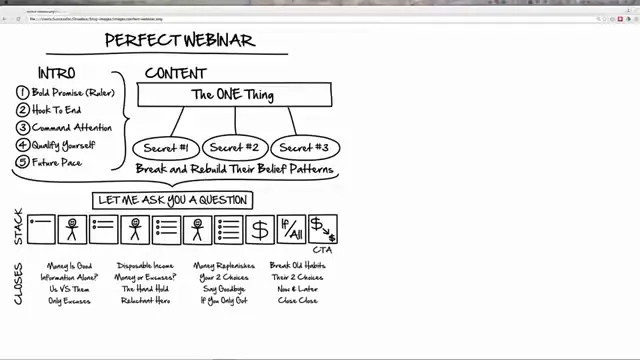
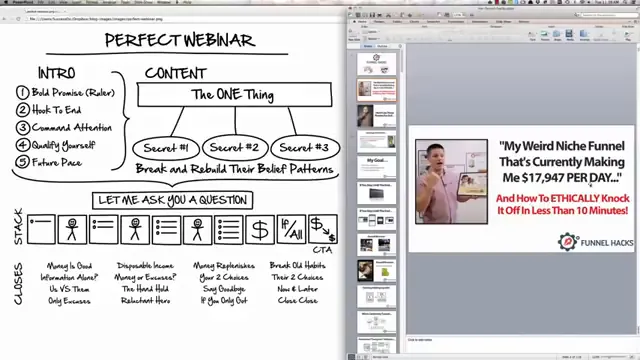
Overview: Three Parts of the Perfect Webinar
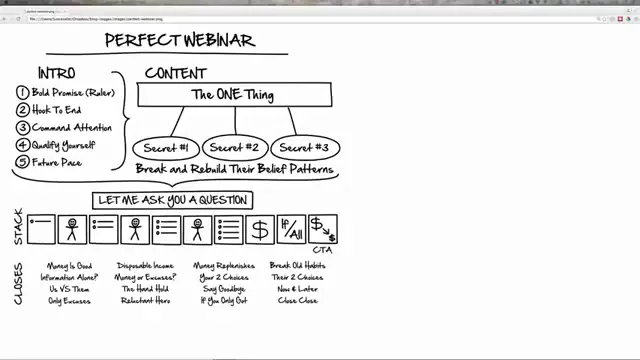
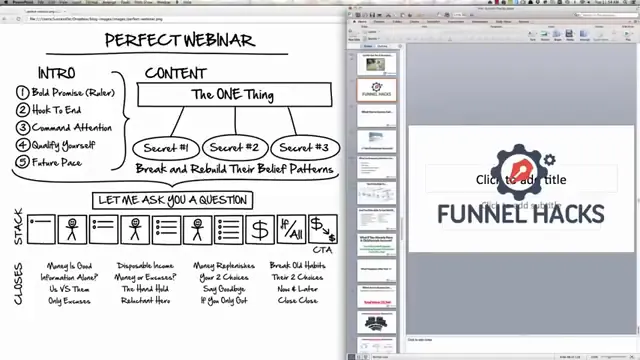
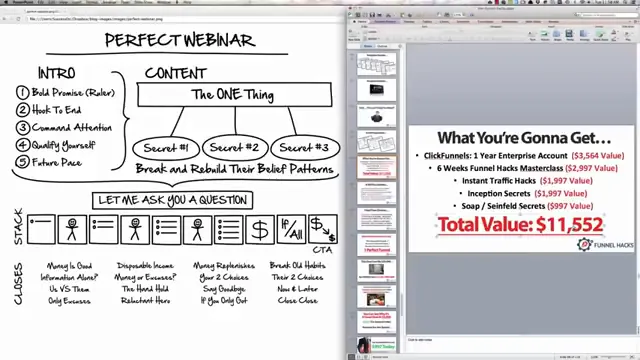
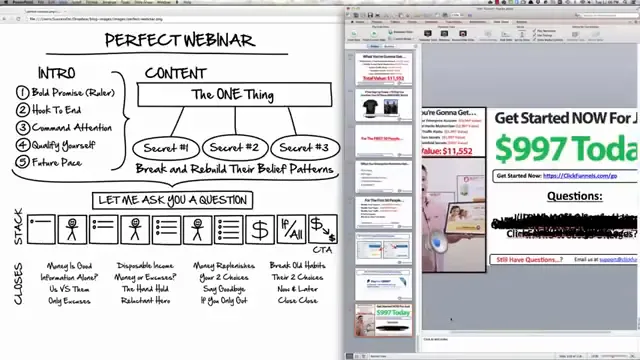
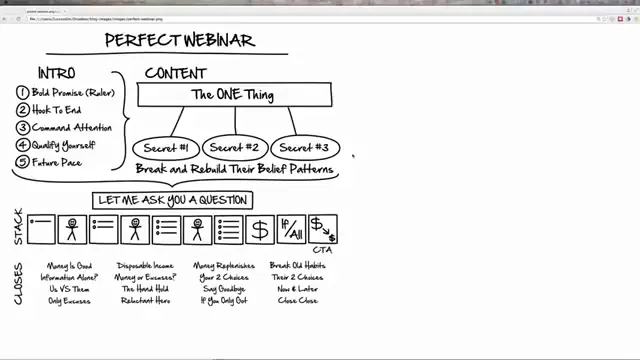
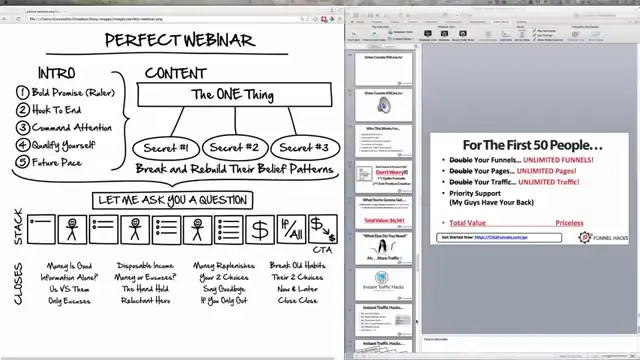
At its simplest, the Perfect Webinar is three parts:
- Induction (Introduction) — The hook, the frame, the energy. You can’t be boring.
- Content — The “teaching” section structured to break the top three false beliefs and rebuild them.
- Close (The Stack) — The value stack, price presentation, trial closes, and call-to-action.
Every single slide and story you use should serve those three pieces. When you design a webinar this way you remove friction and remove excuses—this makes buying the obvious, logical next step.
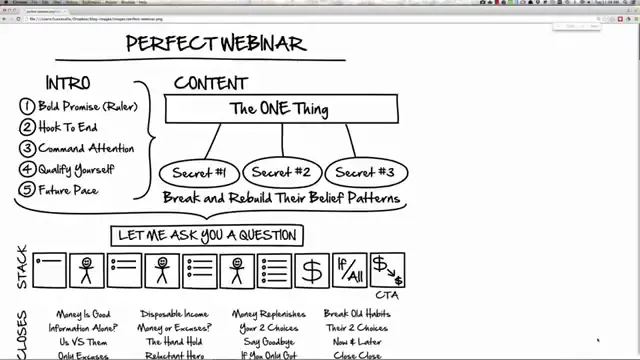
Part 1 — Induction: The Non-Boring Introduction
Too many presenters kill their own funnel before the content even starts because they open like they’re nervous on camera: “Hey everyone… can you hear me? Is the chat working?” That kills momentum. People are checking their calendars, juggling their screens, and evaluating whether this hour is worth it.
Instead, design an induction that does four things in the first 60-90 seconds:
- Grab attention — Start with energy, an unexpected statement, or a quick story.
- Set the frame — Tell them what success looks like at the end of the webinar. Make it vivid.
- Tell them why they should stay — Let people know you’ll give them a takeaway and a way to move forward.
- Ask permission to teach and to sell — This is subtle: ask for permission to show them a path and to offer a solution at the end. People who grant permission are more receptive to the close.
For example, a strong induction line might be:
"If I could show you one simple funnel you could launch this week that starts converting within days, would you stay with me for the next 60 minutes?"
That question narrows the frame (one simple funnel), sets the time expectation, and primes for "yes." When they answer mentally or in chat, you've already begun collecting small commitments—tiny yeses—which is powerful social momentum.
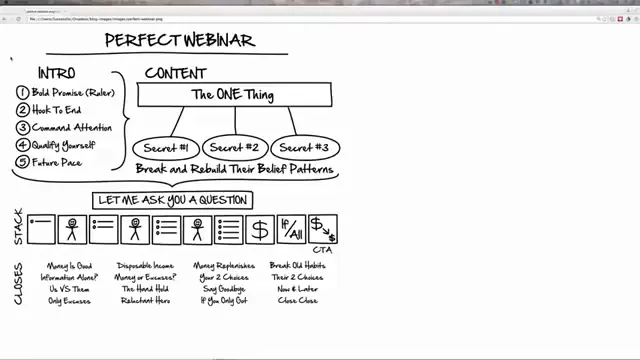
Host Introductions Matter
When you’re speaking on someone else’s stage, how the host introduces you can dramatically influence conversions. I’ve seen people double their sales simply by changing the host intro. The host controls the credibility frame: the more authoritative and specific the intro, the more permission you’re granted. If you can share specific outcomes the audience member can expect (numbers, speed, transformation), the audience is primed to believe.
Part 2 — Content: Teach To Sell (The One Thing + Three Secrets)
Now we move to the heart of the presentation. This is where most people make a critical mistake: they teach too much and they fail to teach in a way that leads to a sale.
The content must be built around one central promise—the One Thing. Everything in the webinar supports this single belief. Then, break the One Thing into three actionable secrets. Those three secrets aren’t just lessons; they are targeted counters to the audience’s existing false beliefs.
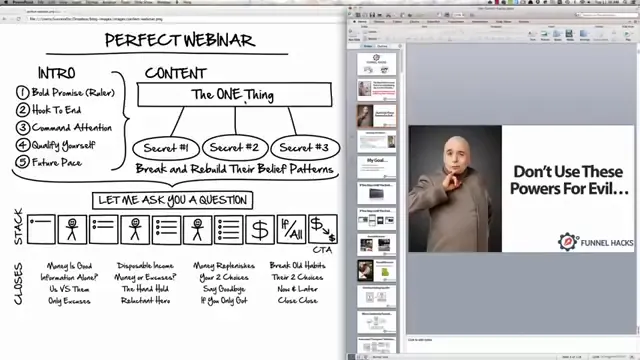
Choose ONE Thing
Ask yourself: what is the single belief people must leave with to want to buy? Keep it narrow. If you try to teach two or three core promises, you dilute the result and the presentation bombs.
Examples:
- Weight loss market: “You don’t need more willpower; you need a specific way to structure meals that fits your life.”
- Marketing funnels: “You can quickly create a high-converting funnel in a weekend using a repeatable template.”
- Local business: “You can fill your calendar with paying clients by running a single, proven webinar funnel.”
Your headline and registration copy should reflect this One Thing because that’s what gets clicks and registrations.
The Three Secrets Model
Under your One Thing you’ll teach three secrets (secret one, secret two, secret three). Each secret targets a specific false belief and does three things: expose the false belief, show why it’s wrong, and rebuild a new belief that supports the One Thing.
Simple formula for each secret:
- State the false belief: Name the objection out loud.
- Demonstrate why that belief exists (sympathy + credibility).
- Show the shortcut or principle that disproves it.
- Give a mini-action or example that proves it’s possible.
Here are common false beliefs I attack in funnel/webinar markets and how to counter them:
- Belief: Building funnels is hard and requires designers/programmers.
Counter: Show a step-by-step template, screenshots of simple pages, and timeline—prove that a drag-and-drop funnel launched in hours converts. - Belief: Funnels take forever to build.
Counter: Reveal a quick-start funnel that requires under 10 minutes of set up for the core page plus simple swap-in content. - Belief: I can’t get traffic or leads; traffic is hard.
Counter: Teach one or two low-cost tested traffic methods and a simple retargeting approach that produces leads quickly.
The secret is never random training. Each secret is a mini-argument proving the One Thing. When you complete all three, you’ve removed the three main friction points that keep people from buying.
Practical Secret Scripts
Use simple "How to X without Y" templates in your slides and copy. This line helps frame your secrets and registration messaging.
Examples to adapt:
- “How to create a high-converting funnel without hiring a developer.”
- “How to generate your first 100 leads without spending $1,000 on ads.”
- “How to close high-ticket clients without cold calling.”
When you fill in that blank for your audience, they instantly understand the benefit and the friction removed.
Part 3 — The Close: The Stack
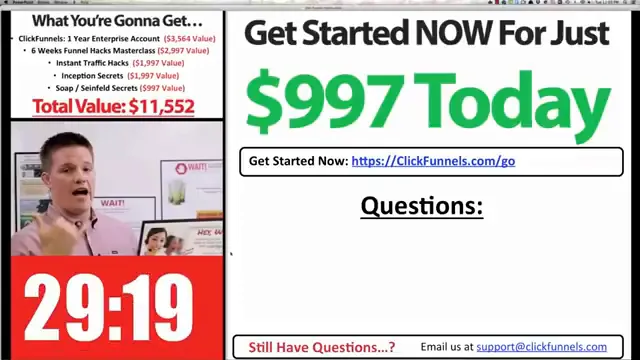
The stack is a structured, deliberate way to present your offer so that price becomes irrelevant compared to value. The stack is the reason the best presenters can get people into programs that cost far more than the attendee’s initial expectation.
How the Stack Works
At its core, the stack lists each element of the offer—product, bonuses, implementation support—then assigns a perceived value to each piece. The stack accomplishes two goals:
- It amplifies perceived value by enumerating every benefit and add-on.
- It reduces friction by making the price look like a no-brainer compared to the total value.
Important rules:
- Start with your core offer, then list every valuable bonus. Make the bonuses short and immediately useful.
- Keep each bonus value concise—$500, $1,500—so the arithmetic feels real.
- Restate the total value, then reveal the actual price last.
Use “If-All” Permission Statements
Before you drop the price, get the audience to agree to three “If-all” statements. These are soft commitments that harden into a yes when you show the price.
Script template:
- “If everything I just showed you does exactly what I promised, would you agree this would be worth $X?”
- “If everything in the package would shortcut your path and save you months of trial and error, would you agree it’s worth $Y?”
- “If you could implement this with the support I’m offering and get the results we showed, would you agree the whole package is worth $Z?”
Three times, get three yeses. This primes them mentally to accept the proposition and justifies the price in their own mind. I learned this technique from Dave Van Hoos and it’s a powerful psychological lever.
Trial Closes Throughout
Don’t wait until the end to close. Embed trial closes—small invitations to agree—throughout the presentation. A trial close is a question that asks for a mental commitment (a yes) while you’re still teaching. Example line: “If that makes sense, say ‘yes’ in the chat.”
Embedding trial closes yields two benefits:
- It keeps a room nodding along mentally—people’s heads literally nod when they agree. This generates momentum.
- It collects micro-yeses that convert into macro-yeses when you present the offer.
The Perfect Webinar Funnel: Pages & Pre-Webinar Flow
Your webinar doesn’t start when the Zoom window opens. It begins the second someone sees your ad or registration page. The funnel around the webinar is critical for both attendance and conversion.
Registration Page: Curiosity First
Your registration page must create curiosity. Don’t try to answer everything. Give enough to entice them but keep a mystery—something they can’t immediately answer for themselves. If the headline gives away the “how,” some folks won’t register because they mentally solve it on their own.
Key elements for a high-converting registration page:
- A headline that promises the One Thing but leaves the method mystery-based.
- A short subheadline clarifying the outcome and time commitment.
- A graphic or image that reinforces the promise (even a seemingly odd or curiosity-building image is fine).
- A brief bullet list of what they’ll learn (three points tied to the three secrets).
- Social proof if available (one quick testimonial or metric).
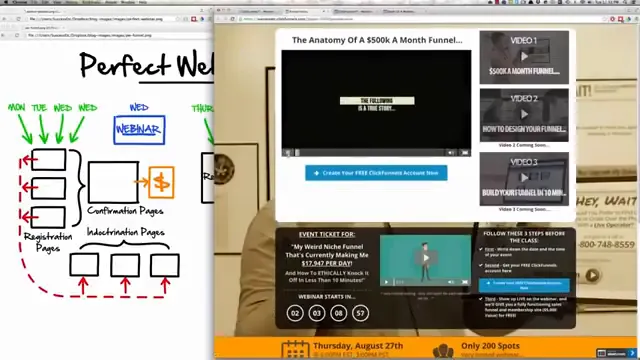
Post-Registration Indoctrination Videos
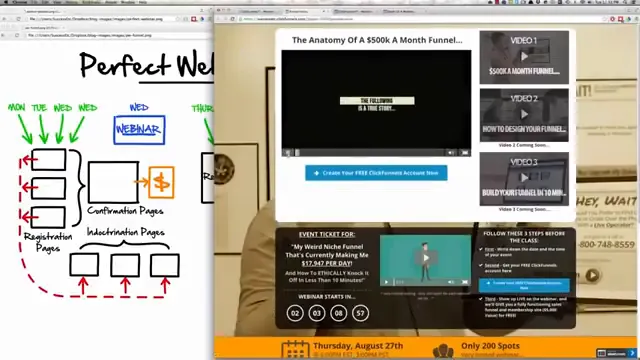
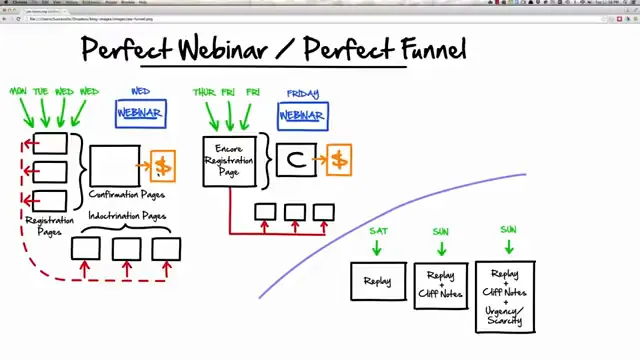
After registration, use an indoctrination sequence to increase attendance. The ideal flow I use is short: register Monday, watch video #1 Monday, video #2 Tuesday, video #3 Wednesday morning, then attend the webinar Wednesday evening. Each video does two things: deliver immediate value and prime the outcome for the webinar.
Why this matters: curiosity gets them to register; indoctrination gets them to show up. When you build momentum before the session they arrive primed and ready—more likely to buy.
Quick Start Offer and “Tripwire”
Many webinar funnels include a small initial offer after registration: a low-cost “quick start” product or trial to cover lead costs and get buyers into a buyer’s funnel. That initial buy also changes the mindset from free to invested—buyers behave differently, and they’re more likely to purchase higher-ticket items later.
Think of it as a backup parachute. When people are halfway through the funnel they’ve already mentally committed to moving forward.
Q&A, Scarcity, and the Final Push
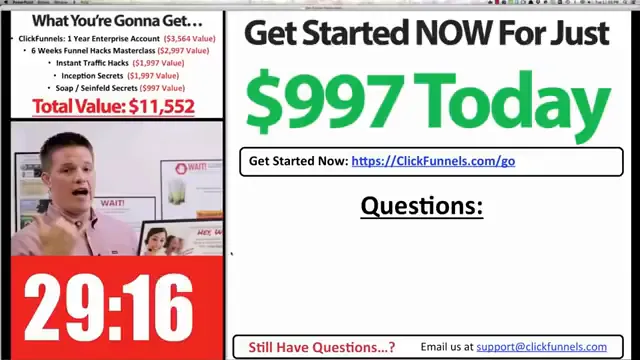
Plan your Q&A and final closing hours. Many teams see a significant portion of sales in the last six hours of a funnel. People need a reason to decide now. A timed bonus or “doors close” scarcity triggers action.
Examples of scarcity/urgency:
- Limited-time bonuses (expires with the webinar replay).
- Limited seats to a coaching group or limited availability for 1:1 spots.
- Extended support bonuses (first 100 buyers get personal feedback).
Use a countdown clock on your order page. Short windows—10 to 15 minutes for a quick decision or a six-hour countdown for replay—work better than indefinite offers because they focus buyers on immediate action.
Handling Questions and Objections
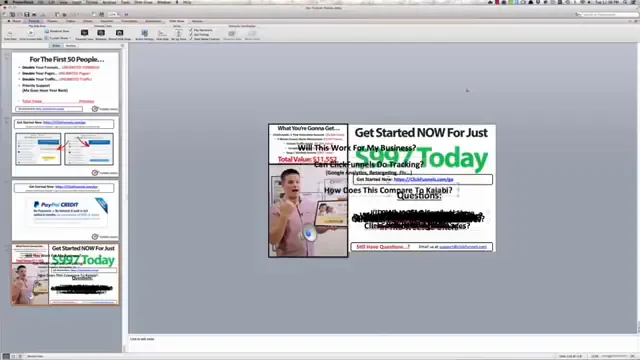
Create a Q&A slide with the most common objections already answered. I often animate a large pile of potential questions and then walk through the top concerns. That reduces live friction and prevents the “I’ll think about it” response.
Common objections to address before they ask:
- “Will this work for my niche?” — Provide a short case study or logic for generalization.
- “I don’t have enough time” — Show how the system saves time and provide an implementation timeline.
- “I can’t afford it” — Restate the transformation, show payment options, and compare costs to results.
Copy Examples & Scripts You Can Use Right Now
Here are practical scripts you can use and adapt immediately. These are battle-tested lines and slide copy patterns that map to the Perfect Webinar framework.
Induction Script (First 60-90 seconds)
Slide/Verbal: “Stop for a second—if I could show you one funnel that you could set up in under 48 hours and begin seeing leads within a week, would you like to stay for the next 60 minutes? Great—here’s what success looks like when you do exactly what I’m about to teach.”
Why it works: Short, bold promise + immediate mental commitment + visualization of success.
Three Secrets Teaser Slide
Slide Copy: “Three secrets to creating a funnel that converts. Secret #1: The fastest page you’ll build that actually sells. Secret #2: The simple traffic hack to get your first 100 leads. Secret #3: The follow-up sequence that converts 2–3x better than your current emails.”
Why it works: It maps the presentation—people know the structure and mentally prepare to say yes 3 times.
Stack Script (Value Presentation)
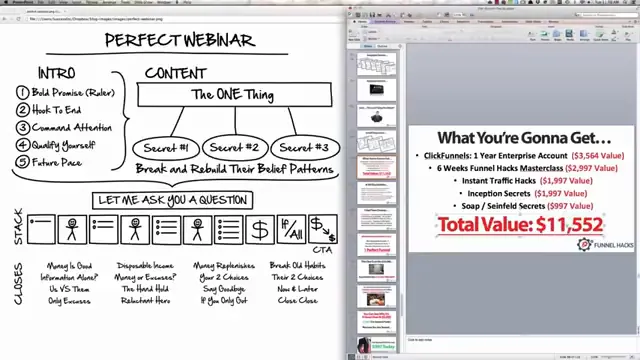
“Here’s everything you get today. Core course: Funnels Made Simple — $2,500. Bonus 1: Swipe files & templates — $997. Bonus 2: Live setup coaching call — $1,997. Bonus 3: Traffic blueprint — $1,497. Total value: $11,991. Today, I’m offering everything for $997 or 3 payments of $397.”
Then use the “if-all” statements: “If everything I just showed you did exactly what I promised, would you say that the package is worth $11,991?” Repeat until you get agreement, then reveal the price.
Designing Slides & Visuals That Convert
Slides should be simple and emotionally resonant: big headings, single KEY line per slide, compelling images that create curiosity, and short bullets when needed. Overly dense slides kill momentum and attention.
Some tips:
- Use curiosity images on pre-registration and registration pages to force clicks.
- In content, use clear numbered lists for the three secrets to create structure.
- In your stack, always pair short descriptive bullet copy with a dollar figure to make the value arithmetic feel tangible.
Metrics & Expected Performance
Benchmarks will vary across niches, but here are practical metrics to target for a profitable webinar funnel:
- Registration-to-attendance: 20–40% is typical; above 40% is exceptional.
- Close rate on live webinars: 10–20% is a good target; with strong stage presence it can go higher on live events.
- Close rate on in-person stage events: It’s possible to convert 40–50% when the presentation and host-intro are optimized.
One critical note: you’ll improve every metric by iterating. Collect data on the most common objections and slide which trial closes land best. Over time, your repeatable script becomes more effective and consistent.
Common Questions & How I Answer Them
How do I choose the top three beliefs to kill?
Start with the obvious ones. Look at the last ten times your audience tried to solve the problem: what stopped them? What do they blame? Typical answers are "it's too expensive," "it's too complex," or "I don't have traffic." Your three secrets should directly target those objections.
How long should the webinar be?
Keep it concise. People's attention spans are short. I typically structure 60–90 minutes where the teaching portion is lean and focused on building belief, not on over-delivering step-by-step implementation. Deliver the transformation and then sell. Over-long presentations dilute urgency.
Can this funnel be used with Facebook traffic?
Yes—tweak for traffic source. The funnel structure is universal: curiosity-based registration, pre-webinar indoctrination, live training that builds belief, and a strong stack close. When using Facebook, make sure the ad and landing page messaging match and that your retargeting sequence nudges registrants to attend.
Practical Checklist: Build Your First Perfect Webinar Funnel
Use this checklist as you build your webinar campaign. It’s the practical execution plan from idea to launch.
- Define your One Thing—craft one clear promise that attendees should believe by the end.
- Identify top three false beliefs (from customer interviews, comments, or past sales conversations).
- Write three secrets—each destroys one belief and rebuilds a new helpful belief supporting the One Thing.
- Create an induction script that grabs attention and frames success within the first 90 seconds.
- Design a curiosity-driven registration page (headline + mystery image + three bullets + CTA).
- Build 2–3 indoctrination videos delivered between registration and webinar to increase attendance.
- Draft your offer and bonuses; itemize the stack with dollar values for each element.
- Write “if-all” permission statements to get three yeses before the price reveal.
- Prepare an animated Q&A slide with answers to top objections.
- Set up countdown/urgency triggers (bonus expiry, limited seat bonuses, timed clock).
- Run a small test and measure registration-to-attendance and close rates; iterate.
Where to Get Resources & Templates
If you want ready-made templates and examples to copy, you’ll find landing pages, email sequences, and stack slides valuable. Below are a few resources and pages to help you get started. Paste these into your browser to explore:
- GFunnel main: https://www.gfunnel.com — At GFunnel you can connect with tools and resources to build funnels and run webinars.
- GFunnel courses: https://www.gfunnel.com/courses — Templates and classes to sharpen your webinar skills.
- GFunnel funnel tools: https://www.gfunnel.com/funnel-home — Practical funnel builders and resources for implementation.
- GFunnel automation: https://www.gfunnel.com/automation-home — For setting up your email/video delivery and countdown automations.
- GFunnel ads & traffic resources: https://www.gfunnel.com/ads — Guidance on traffic strategies and ad funnels to fill your webinar.
- Create account/get started: https://www.gfunnel.com/create-account — Quick access to start building funnels and tracking metrics.
Also check out the Perfect Webinar script giveaway I recommend if you want a plug-and-play script and slide templates: https://profunnelbuilder.com/perfect-webinar/
Real Results & Why It Changes Lives
One clear reason this works is leverage. A single webinar, properly structured and iterated, can generate repeated revenue (live + replay) and scale faster than one-to-one sales. I often tell people: one idea properly executed can make far more difference than a hundred scattered tactics.
I’ve seen funnels that did under six figures in a month and others that have driven millions over time. The repeatability comes from using the same structure and improving the message and offer based on audience feedback.
Final Checklist: Launch Day Ready
On launch day make sure you’ve got these operational items completed:
- Registration page live and tested on desktop & mobile.
- Analytics and tracking in place for registration and attendance (UTM tags if using ads).
- Indoctrination video sequence scheduled and links working.
- Order page built with countdown timer and clear stack presentation.
- Support team briefed to handle payment issues and live questions.
- Backup plan for technology failure (recorded replay ready to serve).
Closing Thoughts: Keep It Simple, Test, and Iterate
If you remember nothing else, remember this: simplify. Focus on one belief, and use your content to destroy the three doubts that keep people from buying. Teach just enough to make the promise believable. Then present a stack that makes the price irrelevant.
Every slide, every story, and every email should serve the mission of building belief. With that approach, you’ll find your webinars not only sell more but also build a community of customers willing to do the work.
The framework works across niches—coaching, software, local businesses, e-commerce. Once you get it dialed in, one webinar can change the trajectory of your business.
Resources Recap
- Get templates and the Perfect Webinar script: https://profunnelbuilder.com/perfect-webinar/
- GFunnel main: https://www.gfunnel.com
- GFunnel funnel tools: https://www.gfunnel.com/funnel-home
- GFunnel courses: https://www.gfunnel.com/courses
- GFunnel automation: https://www.gfunnel.com/automation-home
- GFunnel ads resources: https://www.gfunnel.com/ads
- Create your account and start building: https://www.gfunnel.com/create-account
Want My Step-by-Step Templates?
If you want the exact slides, scripts, and email templates I use (including the indoctrination sequence and the stacked value slides), grab the free Perfect Webinar script and training at the resource link above. It includes examples and step-by-step instructions so you can copy what works and adapt it to your market.
Go Build
Launch something small. Test a single funnel with a single offer. Learn from the questions people ask and then sharpen your three secrets. Over time you’ll be able to predict conversion rates, maximize return on ad spend, and create a reliable revenue engine for your business.
Ready to prototype your first Perfect Webinar? Start by writing your One Thing and the three false beliefs you need to break. From there, plan a short induction and one stack you can present confidently. Keep it simple and test one variable at a time.
See you on the inside—build something people want, teach them to believe it's possible, and make buying the obvious next step.
Need An Account? |
|
Create Your Free Account With GFunnel Today! |
| Create Account |


